

Ahead of tomorrow’s budget, John Healey has pre-announced the AI component: more than £600 million on techUK’s count, covering a National AI Biosecurity Initiative at £165 million, a further £120 million for the AI Security Institute, £120 million into the Sovereign AI Fund and its procurement scheme, £70 million for a vulnerability centre, £60 million for a cyber shield, £18 million for a chip design academy and £30 million for local AI partnerships with mayors.
The framing is sovereignty from start to finish. Healey calls it a distinctively British approach to AI, one that defends the national interest. His AI minister, Kanishka Narayan, puts it more directly: Britain cannot afford to rely entirely on technology built overseas. Every line of the package funds an institute, a lab, an academy or a fund. Ownership of the buildings the computing power actually sits in stays exactly where it is.
The public (and amphio) worked this out before the Treasury did. We polled 1,000 British adults earlier this month about the data centres being built here, and they give a precise figure for what sovereignty is worth to them. The government is about to spend £600 million on the argument and leave the thing that decides whether any of these buildings get consented untouched.
Ownership is worth sixty-seven points
We asked people whether they would support a large new data centre proposed near where they live. The country splits a quarter in favour, two in five against, and a third with no view at all. Net minus 13.
Then we asked the same people about the same project under four named owners.
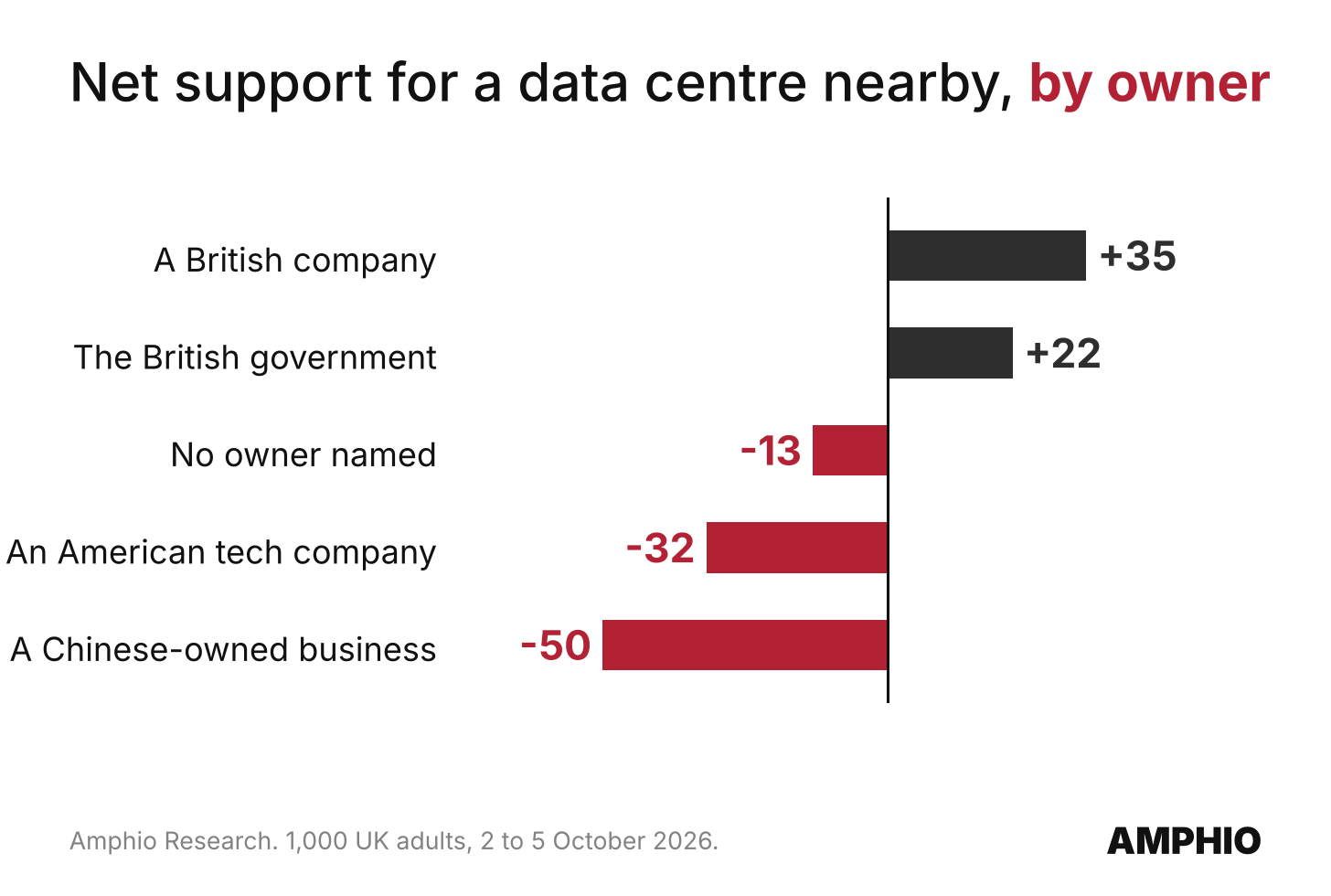
A British company comes out at net plus 35. An American tech company comes out at net minus 32. A sixty-seven point swing.
Of our 1,000 respondents, 525 oppose the project under American ownership. Of those 525, 241 support the same project when it is British-owned. Only 183 people, 18 per cent of all adults, oppose it whoever owns it. The hard core is small. The swing bloc is not.
Every party wants it British-owned
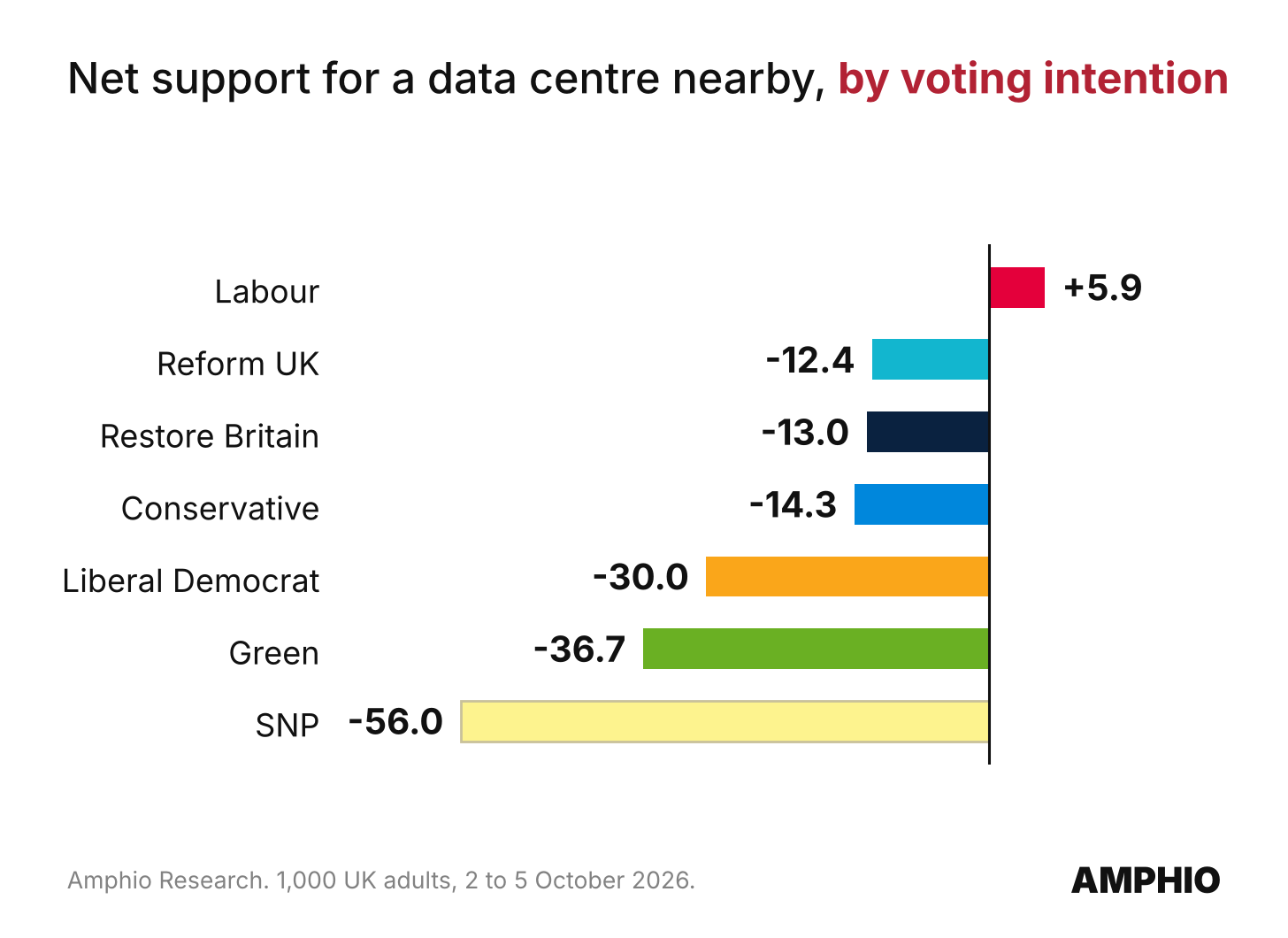
Labour voters are the only group in Britain who are net positive on a data centre near them. The opposition here is green, nationalist and liberal.
Ownership cuts across all of it. Support for British ownership runs at 84 per cent among Liberal Democrats, 81 per cent among Labour voters, 79 per cent among Reform UK voters, 79 per cent among Conservatives, 77 per cent among Greens, 76 per cent among the SNP and 76 per cent among Restore Britain voters.
Where the opposition sits
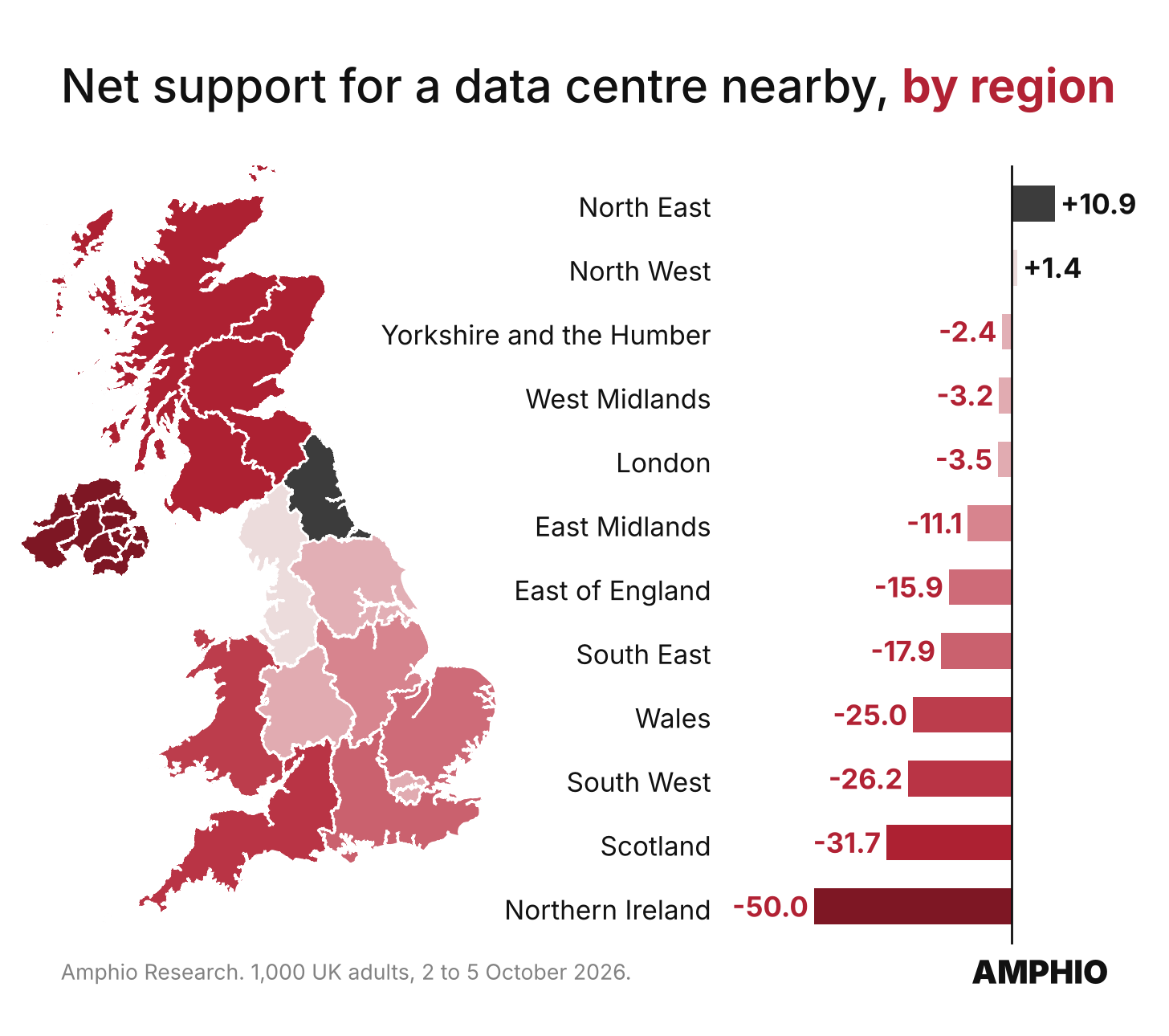
The North East is the most supportive region at plus 11 and the South West the most opposed in England at minus 26, while opposition deepens outside England: Wales minus 25, Scotland minus 32, Northern Ireland lower still. What separates them is how much a British owner recovers: 91 points in the North East and 85 in the South West against 50 in Scotland, where belief that the computing power goes abroad runs at 39 per cent and support for pausing approvals at 57.
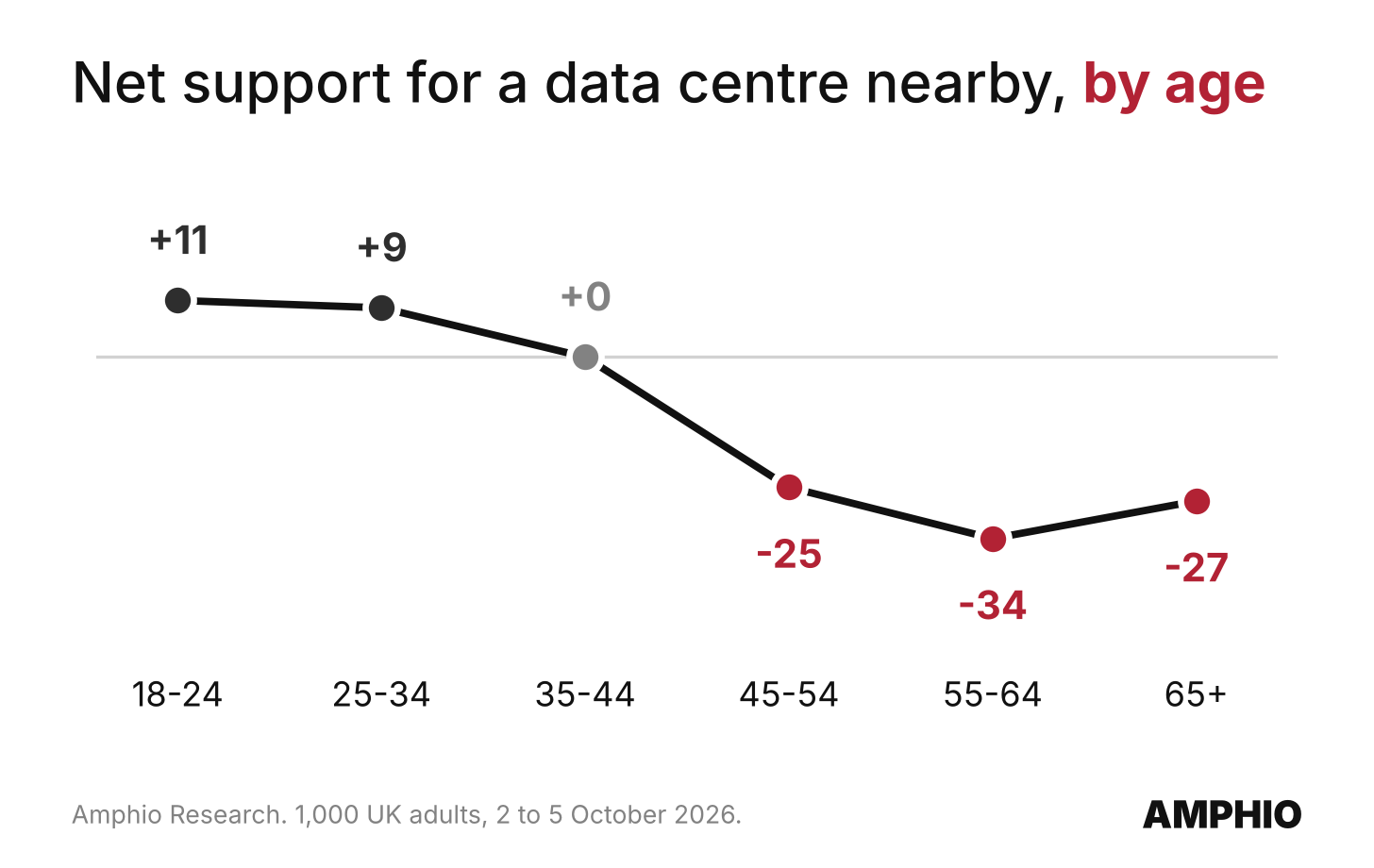
Support falls off a cliff at 45. Under-45s are net positive at plus 6 and over-45s net minus 28, and proximity makes no difference: over-45s who already live near a data centre sit at minus 29 against minus 28 for everyone else. The older half is also the more movable half, running from minus 49 under an American owner to plus 32 under a British one, a swing of 81 points against 49 among the under-45s.
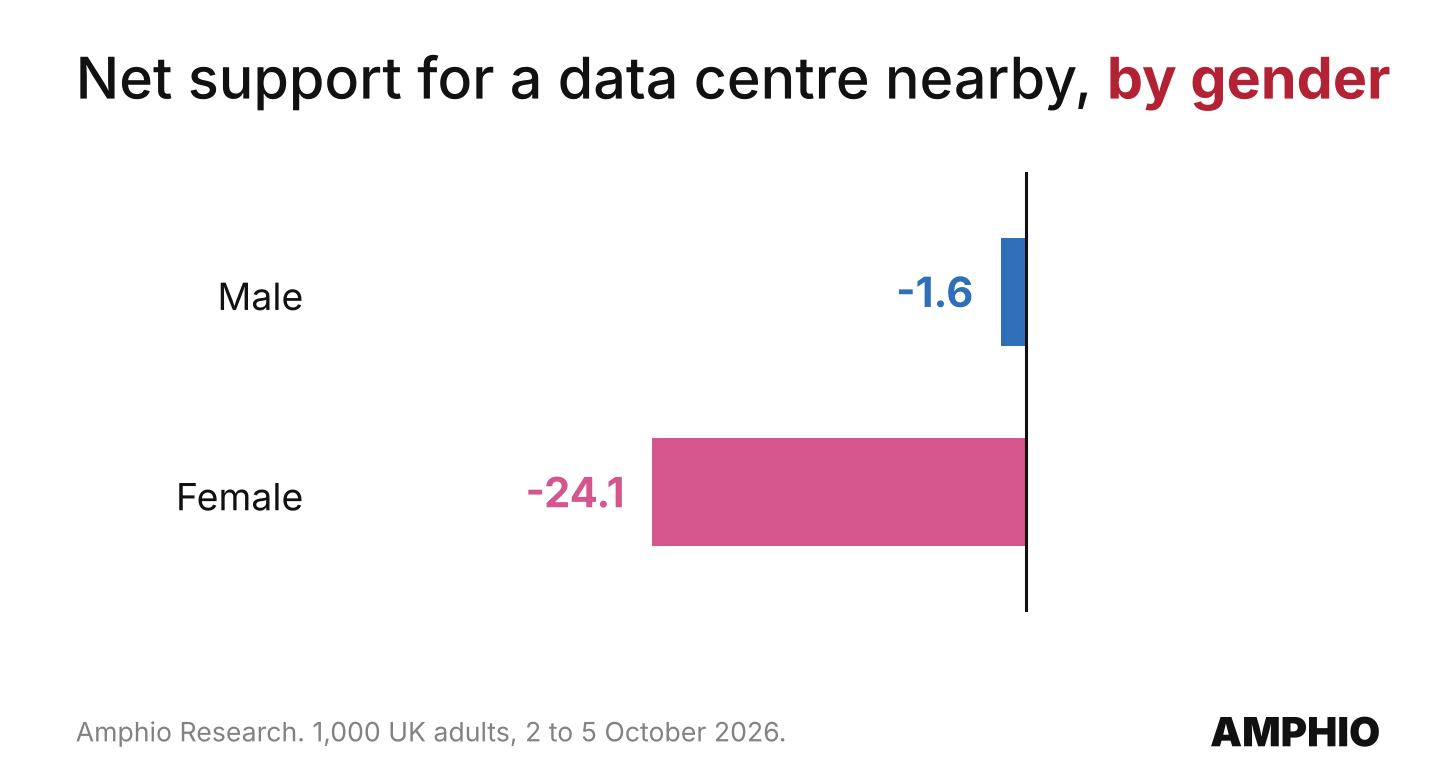
The gender gap is 22 points. Men sit at net minus 2 and women at minus 24. It runs widest among the over-65s at 34 points and 35 to 44 year olds at 33, and it closes to nothing among 55 to 64 year olds, where men and women both sit at minus 34.
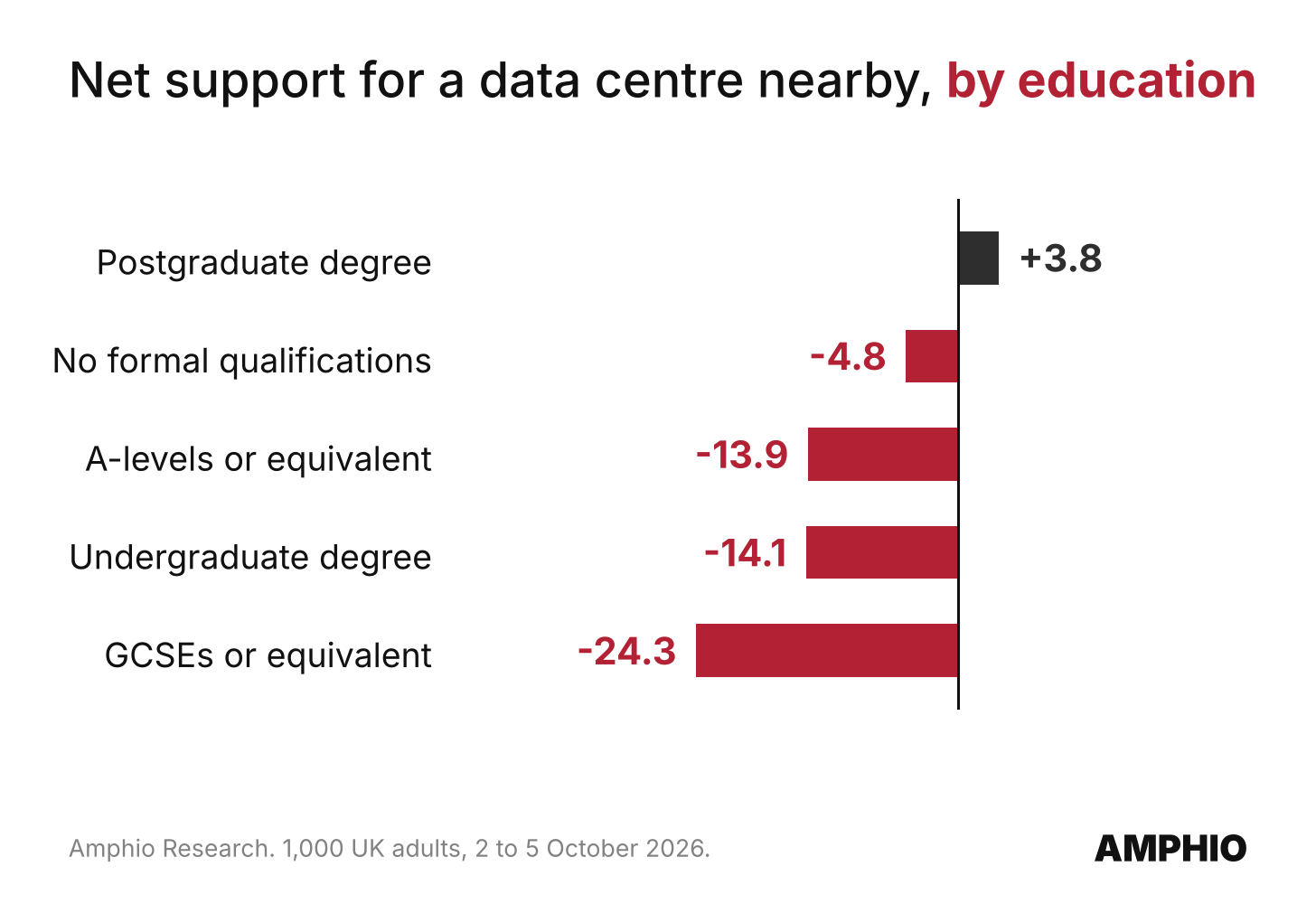
Postgraduates are the only group in the country who are net positive. GCSE holders are the most opposed. People with no formal qualifications sit above both A-level and undergraduate holders, so anyone expecting more education to mean more support will misread this.
The covenant solves a different problem
The FT reported this morning that the government is weighing a data centre covenant, possibly for tomorrow, requiring developers to invest in local communities in exchange for priority grid access or faster planning. The Sovereign AI Leadership taskforce proposed something similar last week, letting host councils keep more of the business rates.
We tested six concessions.
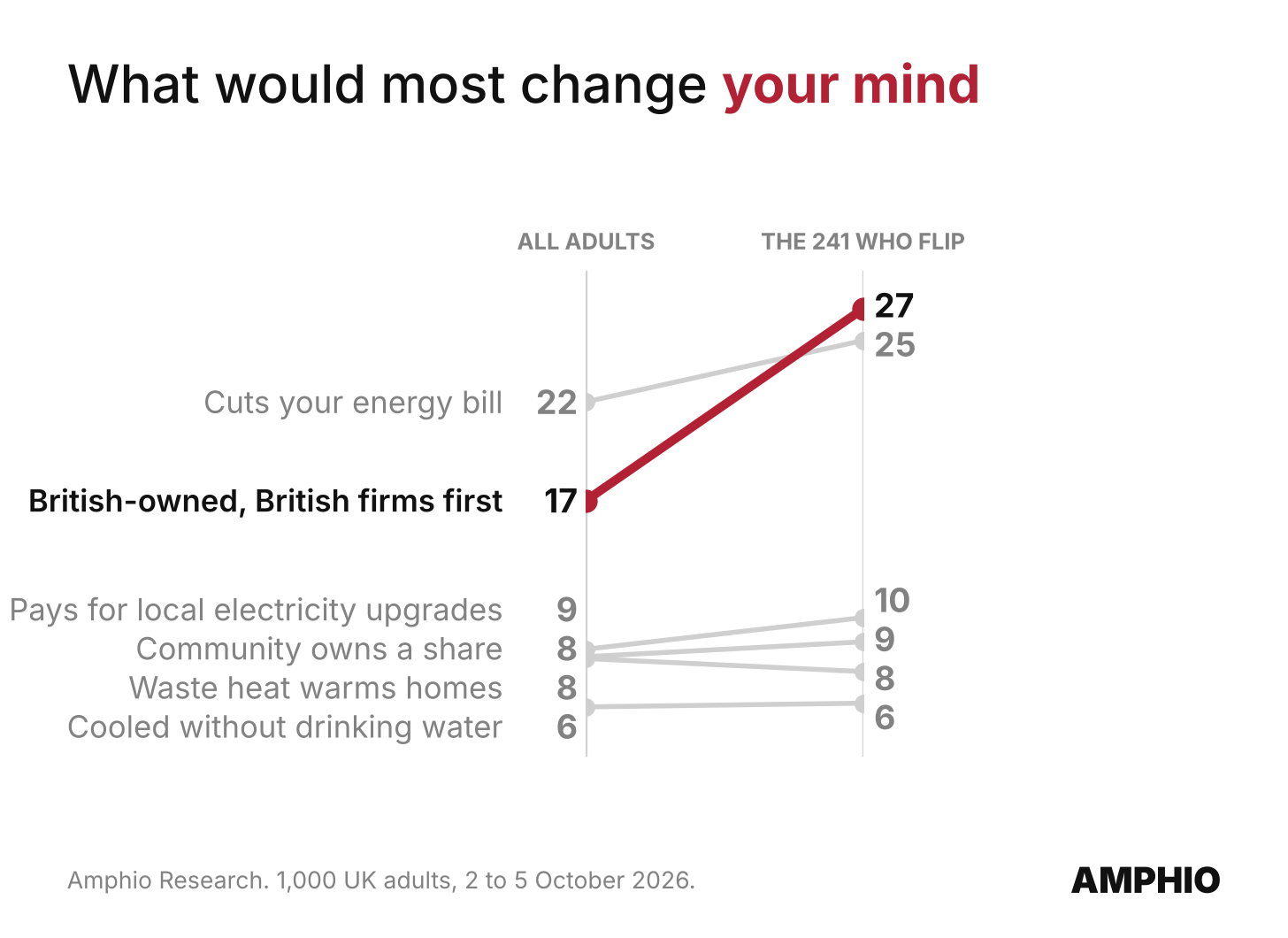
There are only two live currencies, energy bills and ownership. Everything else sits in single figures, including the waste heat, the community equity and the water cooling that the industry talks about most.
Local investment belongs to the single-figure family. Paying for local electricity upgrades polls at 9 per cent and a community stake at 8. Cutting a household’s energy bill polls at 22, but the covenant as reported puts cash in a council’s hands, and a council’s budget is a long way from a household’s bill. Business rates retention is weaker still, because it’s a transfer between the Treasury and the council that never appears anywhere in a resident’s experience.
Among the 241 people who flip on ownership alone, British ownership is the top answer, narrowly ahead of the energy bill.
What happens next + future of Amphio
My instinct is the covenant ships in some form and still doesn’t move consent. If it goes out with nothing on ownership or first use, net support for a local data centre will still be net negative.
So the fight moves from planning to procurement. Who gets to use the compute is a procurement question, and it’s the one the public is already answering. The Sovereign AI Fund and its R&D procurement scheme are where this gets settled.
Sooner or later a developer will turn up with a British ownership structure. A UK-majority JV, a pension fund stake, a government golden share, whatever shape it takes. They will find (with the right framing) it is worth more than every community benefit package ever written and it probably isn’t close. Ownership is worth 67 points. The best concession we tested is worth 22.
On Amphio: I’ve just got back from LA Tech Week, where I met with several of the largest AI/defence infrastructure developers in the world. Hardly anybody out there takes the UK remotely seriously as a place to build anything. Returns too small, too late. People too cautious, too slow.
I met plenty of very bright young Brits and Europeans while I was there. They have all left and none of them are coming back e.g. 24-year old from Cambridge (MEng Imperial) making $400k+ a year for a drone software company in Newport Beach, living in a villa a 5-minute drive from the ocean. Idiot, he could Londonmaxxing right now from a flat in Walthamstow.
I’m headquartering my own company in California this year for the same reason. Feel free to get in touch for a goodbye coffee :)
james@amphio.com