

“The data center folks have found a sweet spot in the state that has limited regulations, limited enforcement, limited code, and they’re coming faster than we can keep up with.” — Jim Holcomb, County Commissioner, Hill County, Texas
Prologue: Hill County, TX
On the morning of May 12, 2026, five county commissioners took their seats in a courtroom in Hillsboro, Texas, fifty-five miles south of Fort Worth. The room was full. By three votes to two, Hill County, with a population of thirty-seven thousand, passed a one-year moratorium (suspension) on new data center construction in its unincorporated areas. The first county in the history of Texas to do so.
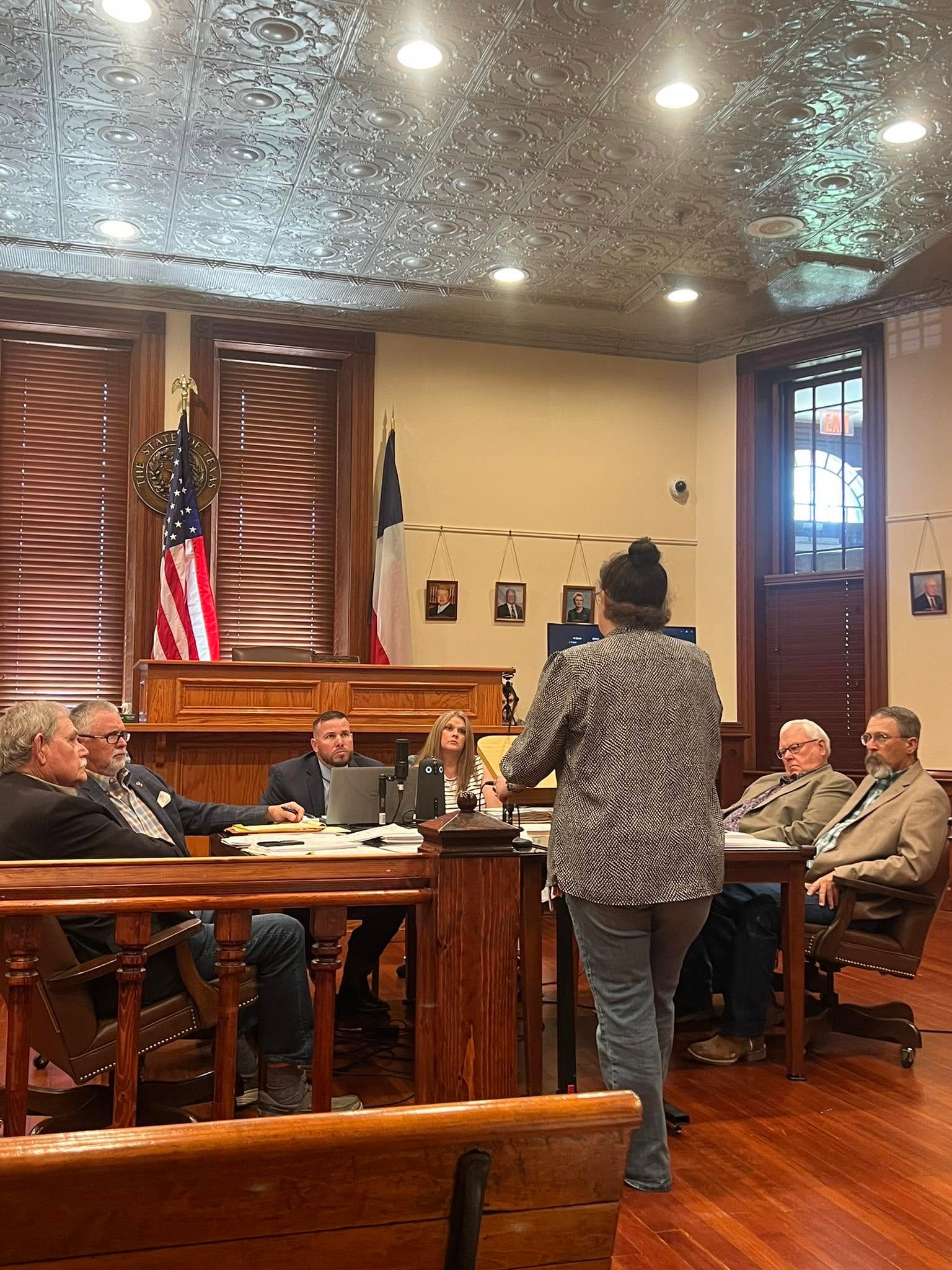
Pictured: Hill County Commissioners voting to pass a temporary moratorium on data centers, May 12 2026.
This isn’t California or New York, where any attempt to build something is treated as a crime against humanity. Texas is the most pro-development state in America and the center of gravity of the AI sector’s buildout, with an estimated 400 data center projects operating or in development. Developers went there because the land is cheap and the state leaves builders alone. The Hill County vote, however, put as many as eight planned projects in jeopardy overnight. A Dallas developer sued almost immediately. Within a month the county backed down. The moratorium was rescinded and replaced with a mandatory Major Industrial Development Checklist and review framework. In other words, mountains of red tape of the kind you’d expect to encounter in Greenwich or Jackson Hole.
Next door in Hood County, commissioners tried twice to pass a similar pause and failed twice, after a state senator warned them they were acting beyond their legal authority. Developers sued the county anyway, twice. The county clerk called her county’s failure to act the biggest disappointment of the whole episode. “Hood County should have been the tip of the spear,” she said.
In Angelina County, in the pine country of east Texas, residents packed the commissioners court to oppose a facility proposed for the site of an old paper mill outside Lufkin. The county judge told them he shared their concerns and could do almost nothing with them. “The Texas legislators have consciously limited what we can do,” he said, “and they’ve done it on purpose.”
Then the state itself began to move. On May 18, the Texas Agriculture Commissioner, an elected Republican, called for a statewide moratorium on hyperscale data centers. On June 10, Governor Greg Abbott ordered the Public Utility Commission and ERCOT to draw up rules requiring data centers to generate their own power and recycle their own water, at their own expense. Three weeks later, at a campaign stop in East Texas, he went further: “We must prohibit them from building AI data centers in rural Texas neighborhoods.” He wants their tax break eliminated too. This is the same governor who stood up in November to celebrate a $40 billion Google investment and call Texas the epicenter of AI development. Eight months from champion to prohibitionist. That is how fast this thing is moving. Governor Abbott has no doubt been reading the same polling as me.
Everything I’ve read about the AI race is set in the same few zip codes, the labs of the Bay Area and the trading floors of New York. Its physical body however belongs to rural America, and the body’s future arrives first in places like Hillsboro, in county commissioners courts that open with a prayer, and in rooms where a nine-figure project can die on a Tuesday morning in front of five unknown elected officials.
The AI sector’s buildout runs on three inputs. The first is land, and the industry has a plan for land: site acquisition in low-regulation zones. The second is power, and the industry has a plan for power: behind-the-meter generation and billions in committed grid spend. The third is the consent of the people who live beside these projects. Virtually nobody has a plan for consent beyond regional PR firms who charge $3k a month for some F2F with local politicians more interested in what time Chili’s closes.
Part I of this essay documents the collapse in public opinion of data centers, the fastest ever recorded against any category of infrastructure. Parts II through V describe the machine that produced it and the election that is about to weaponize it. Parts VI and VII explain why the position is far more winnable than it looks, and exactly how it gets won. Part VIII is a checklist for anyone looking to not have their pipeline crushed between now and November.
Part I: The Collapse
By the market research industry’s standards, public opinion in America does not usually move quickly. Views on nuclear power took a decade and a meltdown to shift ten points. Same-sex marriage, the textbook case of rapid attitude change, moved roughly twenty points across ten years. Pollsters build entire careers on swings of five.
Last September, Heatmap Pro asked Americans for the first time how they would feel about a data center built near their home. The country split down the middle: 43% in support, 42% opposed, 15% unsure. A coin flip question where most respondents could barely describe what one was. In short, America had not yet formed an opinion.
This February, the same tracker had opposition at 51%. An increase of 9 points.
By June, the question was settled. In the latest wave, fielded by Embold Research across 4,118 registered voters in all fifty states, at least seven in ten Americans opposed a data center near their home. An outright majority of the entire country, 55%, described themselves as strongly opposed. Support had fallen to 21%. Heatmap’s own summary was that the public had “swung 49 points against data centers in just nine months.”
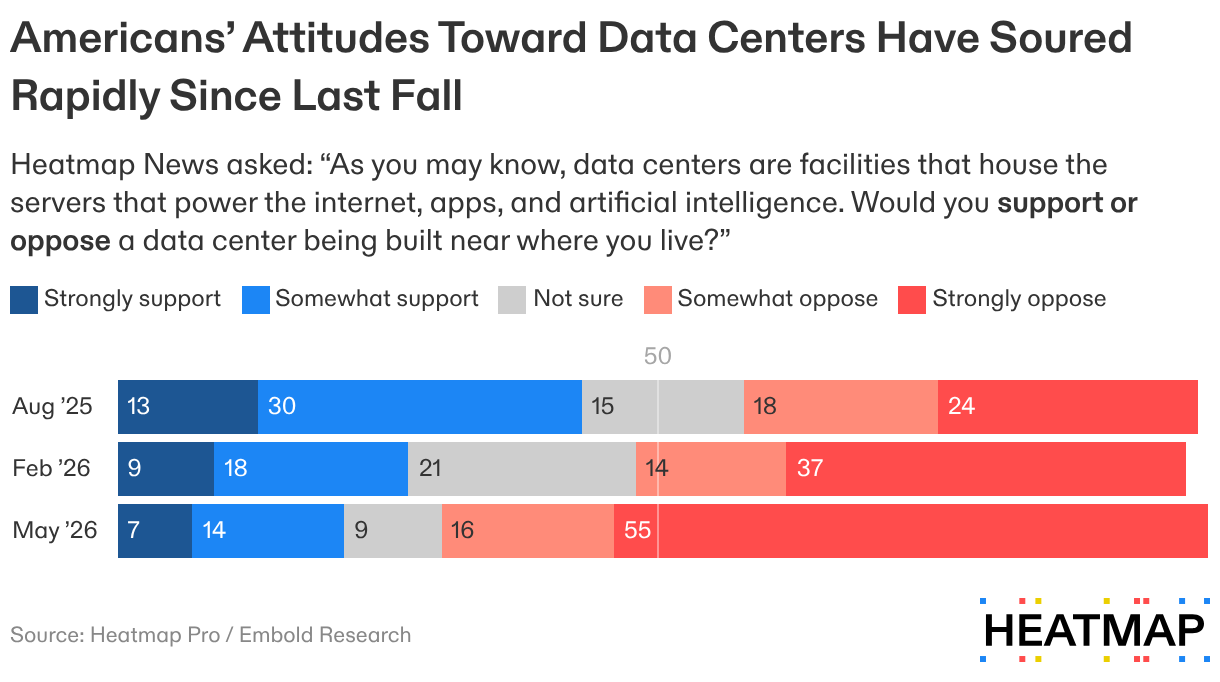
Nine months. Charles Franklin has run the Marquette Law School poll for fifteen years and says he has never tracked anything develop faster. There is no equivalent in the modern polling record for an infrastructure category. Wind farms took twenty years to become contested. Data centers went from unknown to the bottom of the table in under two.
Since 2001, Gallup has asked Americans whether they would oppose a nuclear power plant near their home. Across twenty-five years of asking, through Fukushima, opposition never once exceeded 63% . In March 2026, Gallup put the same question about data centers into the survey for the first time. Opposition came back at 71%. In the same survey, a nuclear plant drew 53%.
To clarify: Americans would now rather live beside a nuclear power plant than a data center.
For the developers reading this looking for geographic refuge in the crosstabs - you will not find one. No region of the United States polls below 69% opposition. Among Americans aged 18 to 34, opposition runs at 80%: the generation that actually uses these models every day is the most hostile to their physical footprint. And then there is Virginia, the industry’s home turf, host to the largest concentration of data centers on earth and two decades of lived experience with them. Support for new construction there fell from 69% in 2023 to 35% in an April 2026 Washington Post poll. The sector’s oldest host community has turned against it by nearly two to one. Where familiarity was deepest, the collapse was steepest.
To summarise, social license is an input to every data center on every pipeline in the West, and that input has been repriced by 49 points in nine months. If any other core input had moved like that, it would be the only item on the sector’s agenda.
This is on almost no one’s agenda.
A prediction, the first of several in this essay: national opposition to local data center construction does not fall below 65% on any credible tracker before the November midterms. Nothing that would push the number down currently exists. Everything pushing it up is accelerating, and the next four parts are about what, exactly, is doing the pushing.
Part II: There Is No Cavalry
Every industry that gets into political trouble has a mental model of who will save it. Oil has Texas. Coal had West Virginia. Crypto bought itself a Senate caucus. For data centers the assumed cavalry was pretty specific: rural counties would welcome the tax base, and red states would defend capital investment on principle. These were reasonable assumptions to make, given they had held for every category of American infrastructure for fifty years.
Here is what the polling shows instead. In Heatmap’s June wave, 78% of Harris voters oppose a data center near their home. So do 63% of Trump voters. The fifteen-point gap looks meaningful until you notice that both numbers are landslides. There is no version of American politics in which 63% of a party’s voters oppose something and its elected officials defend it for long.
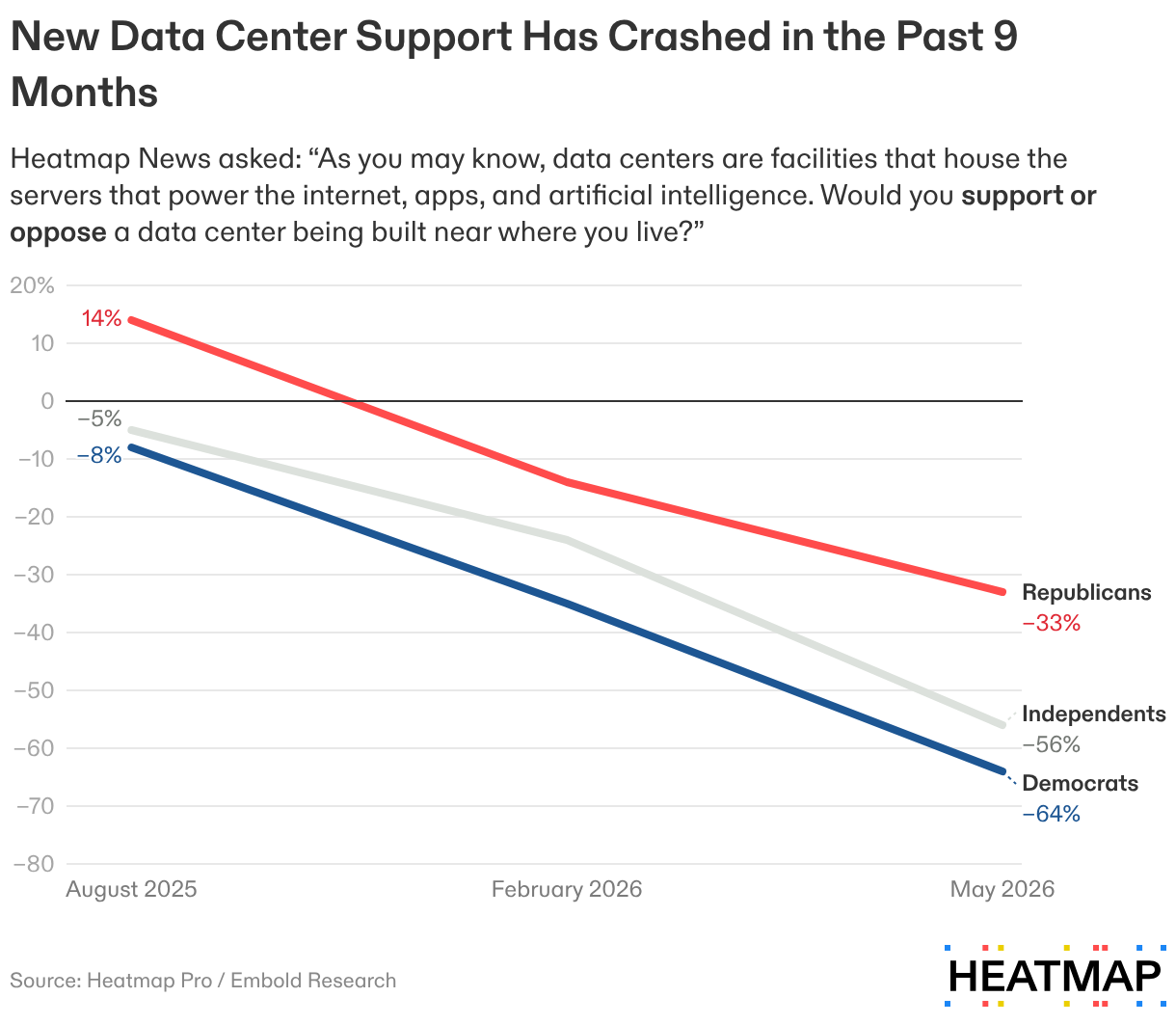
The rural numbers are worse. Rural Americans oppose local data centers 73% to 19, a net of minus 54, which makes the countryside more hostile than the suburbs and more hostile than the cities. Now compare that against the industry’s siting map. The entire buildout strategy of the last three years has been to move into exactly these places, on the assumption that they would compete for the investment, when actually they’ve turned out to be its most committed opponents.
The sector needs to stop for a moment and register how strange this is in a country that no longer agrees on anything. Polarization carries one consolation for anyone under attack: if one tribe decides to hate you, the other tribe will adopt you out of spite. That reflex has rescued oil companies, gun manufacturers and pipelines. It is the closest thing American public life has to a safety net, and data centers fell through it. The physical substrate of the AI economy has achieved the rarest outcome available in this country, genuine cross-partisan consensus, and the consensus is against them. Bravo.
So what have we learnt in the last nine months?
No audience belongs to a data center developer by default
No district is red enough to guarantee a welcome
No county is poor enough that the tax revenue argument wins on its own
Later in this essay I will show that winning these people over is more achievable than the numbers in Part I suggest. But the sector needs to be honest with itself. The cavalry is not coming, because the cavalry has joined the other side. They got there first.
Which raises the question: fifty years of pro-development instinct in rural America did not dissolve on its own in nine months. Someone dissolved it. Part III is about who.
Part III: The Machine
The industry’s comfort word for its opponents is NIMBY. It implies something spontaneous, local and disorganized, a scattering of retirees with yard signs who will tire themselves out after the second hearing. Spend any time digging into the last nine months and you realise you are up against an incredibly well-funded, organised, layered machine.
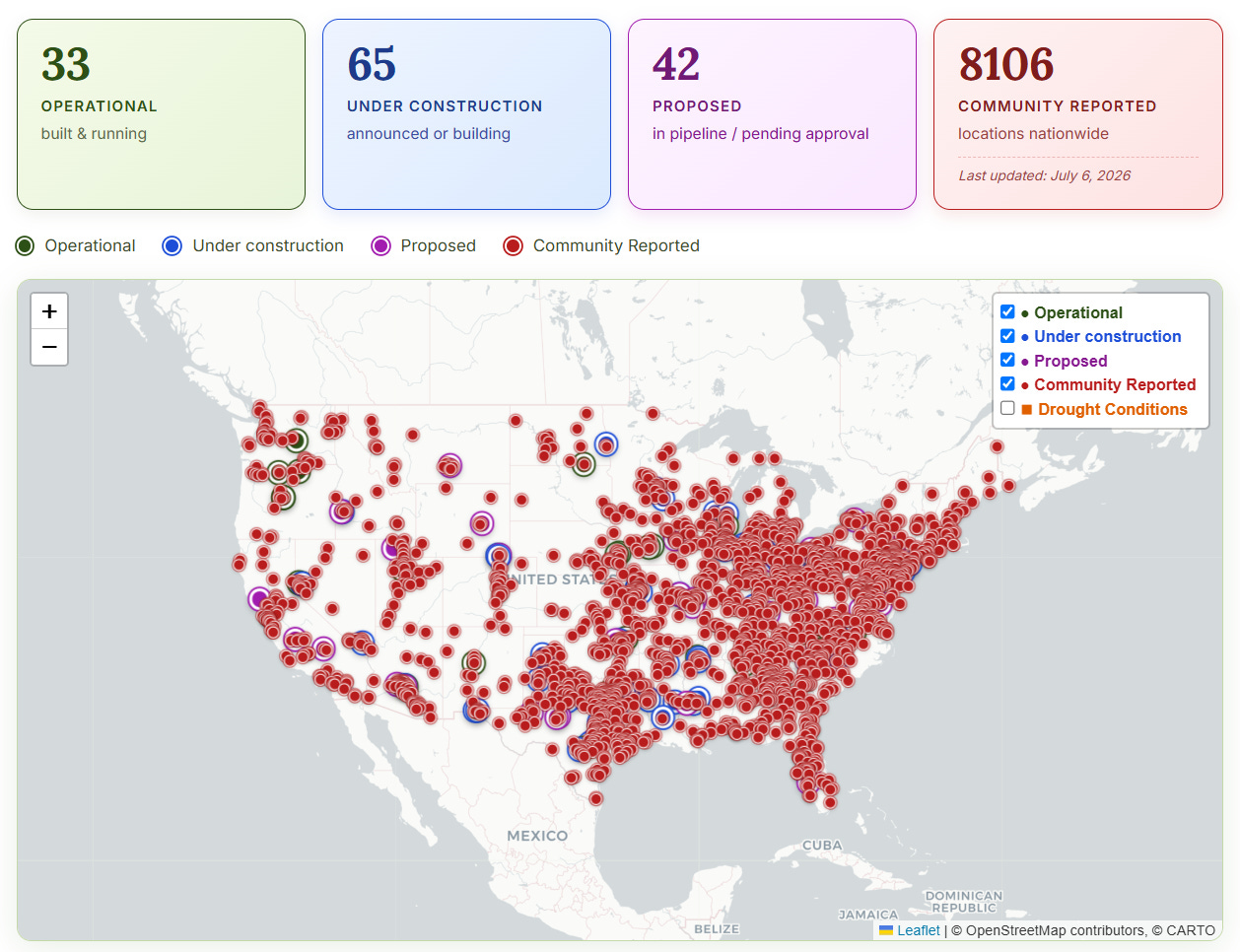
Start at the bottom. Data Center Watch, a research project that tracks opposition activity across the country, counted 396 active local opposition groups at the end of 2025. By the end of March 2026 it counted 833, spread across 49 states. The number of organized groups fighting data centers more than doubled in a single quarter. Petition volumes in those three months nearly matched the entirety of the previous half year. And the groups are no longer just reactive in nature. Data Center Watch found opposition mobilizing before any paperwork had been filed, organizing against projects that existed only as gossip. Consider what that means operationally for your pipeline. The opposition now has sensors in the ground ahead of the industry’s own announcements. It is a distributed early-warning network covering the whole country, staffed by volunteers, running at zero marginal cost, and the sector has built nothing equivalent. You can watch it operate in real time: the trackers at datacenterwatch.org and the live opposition map at brockovichdatacenter.com update continuously, like weather radar for a hurricane the industry thinks are scattered showers.
One layer up sits the professionals. The December letter I will come to in a moment was organized by Food & Water Watch and signed by, among others, the Sierra Club, the NRDC, Greenpeace and Friends of the Earth. These are organizations with full-time litigators and standing relationships with every national newsroom, and they have spent decades running this playbook against pipelines and coal plants. They have also started publishing doctrine. In December 2025 the AI Now Institute released a “North Star Data Center Policy Toolkit,” a manual for using local and state policy to stop data center expansion. A month later MediaJustice published its own organizing guide, The People Say No. Read those documents and then ask what the equivalent artifact is on the development side. There isn’t one. For the opposition, defeating your project is the job. For most developers, community engagement is a line item, usually the smallest one on the sheet.
Another layer up, the machine touches the legislature. On December 8, 2025, more than 230 organizations co-signed a letter demanding a national moratorium on data center construction. One hundred and seven days later, a national moratorium bill appeared in Congress, the AI Data Center Moratorium Act, S.4214 in the Senate and H.R.9442 in the House, its provisions tracking the letter’s demands closely. Below the federal level, more than 300 data center bills landed in state legislatures in the first six weeks of 2026. Statewide moratorium proposals are moving in 14 states. Maine passed both chambers before a gubernatorial veto killed it, and the override failed narrowly. New York’s legislature has passed a one-year pause on large permits. At the local level, 54 moratoriums have already been enacted, with nine more pending. Follow the full arc and it runs from a Facebook group to a filed bill inside months. That is a textbook conversion funnel, and someone built it.
Which brings us to the money. According to a May 2026 report by the Bitcoin Policy Institute and testimony delivered to the House Ways and Means Committee in February, more than $2 billion has flowed through foreign-tied charitable vehicles into the American advocacy infrastructure now aimed at data centers. The Wyss Foundation, controlled by a Swiss national, has moved roughly $700 million into US advocacy through its action fund. The Oak Foundation, also foreign-controlled, has granted over $750 million to more than 150 American groups. The American Energy Institute traces $39 million in foreign-linked funding to twelve organizations actively opposing data center development. A separate network documented by the New York Times, and now the subject of four House committee inquiries, has produced anti-US-AI-infrastructure content for five years. Chinese state media outlets run openly attributed campaigns against American data centers while Beijing cuts the power bills of its own AI operators. And in a follow-up published two weeks ago, the same researchers attributed $23.6 billion in stalled or blocked American projects specifically to what they call a China-aligned ground game.
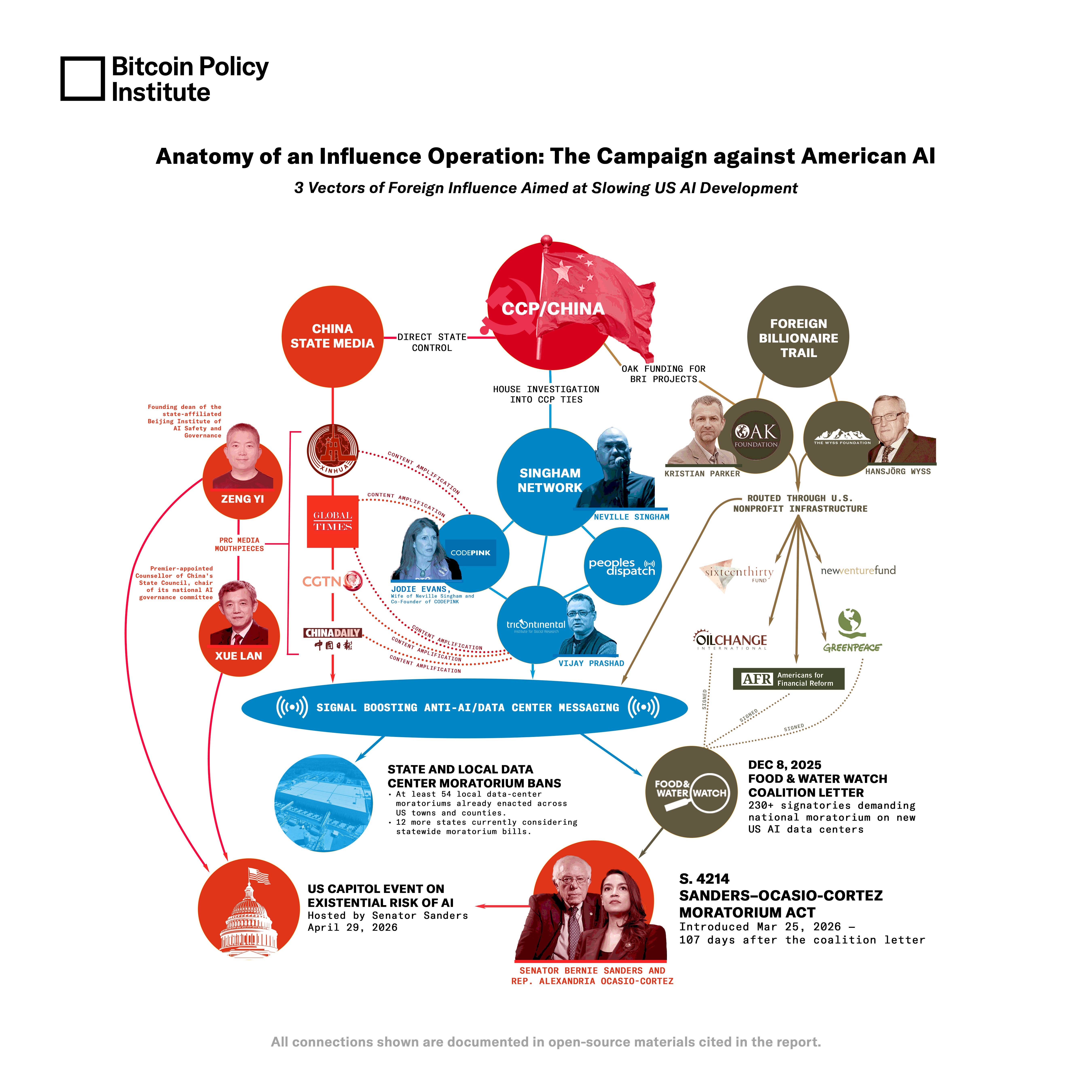
Now take a step back and realise what this machine actually is. The opposition is running a modern political campaign. It sets the narrative in a community before the developer has scheduled a town hall. It pairs distributed local organization with national message discipline. It escalates from petition to ordinance to statute along a tested path. Against this, the industry is running a permitting playbook from the 90s: acquire quietly, file, present the PR firm’s benefits package at the statutory hearing, absorb the anger, appeal, repeat.
A second prediction. Active opposition groups exceed 1,200 by election day. The count doubled last quarter and two full quarters remain, so 1,200 actually assumes the machine slows down.
The obvious question is what all this has already cost the sector. Onto the invoice…
Part IV: The Ledger, and the Texas Tell
Opinion is one thing. Money is another.
In the first quarter of 2026, according to Data Center Watch’s tracking, at least 75 projects worth roughly $130 billion were blocked or delayed by local opposition. Three months. The figure is the largest ever recorded in a single quarter, and it roughly equals the total for all of 2025. Heatmap Pro’s separate count, using a stricter definition, found 20 projects cancelled outright in the same window, double the previous quarter, erasing more than $41 billion in planned investment and at least 3.5 gigawatts of electricity demand. I will let you do the maths on where the annual figure will land if the first quarter turns out to be the slow one.
We established in Part III that opposition groups are forming on rumor, before any filing exists. The financial consequence is that political risk has moved upstream of acquisition. A developer can now inherit an organized, named, fundraising opposition group as a condition of the site, before owning the site. In Livingston County, Michigan, a farming area that went 61% for Trump, hundreds of residents packed public meetings against a proposed 1,000-acre, billion-dollar Meta facility until the company withdrew. The county was chosen precisely because it was considered friendly to business.
Which brings us to the Lone Star State. On paper Texas is the perfect siting jurisdiction and the industry has treated it accordingly: an estimated 400 projects operating or in development, the largest concentration in the country. The reasoning is obvious. Texas counties have almost no zoning power, so developers have increasingly routed projects into rural unincorporated land where, as one Hill County commissioner put it, the regulatory “sweet spot” sits. But the same absence of process that makes these places easy to build in makes them impossible to read. No zoning means no hearings until late, no hearings means no early signal, and no early signal means the first time a developer meets the community is often the day the community has already organized. The prologue showed what that bomb looks like when it detonates. Hill County’s moratorium was the first in state history, Hood County has been sued twice over its attempts, and in Angelina County the anger is now aimed at a judge who agrees with the residents but holds no legal power to act.
So what do Texans actually think? Focaldata has been polling the state’s registered voters on exactly this, and two findings matter more than all the others.
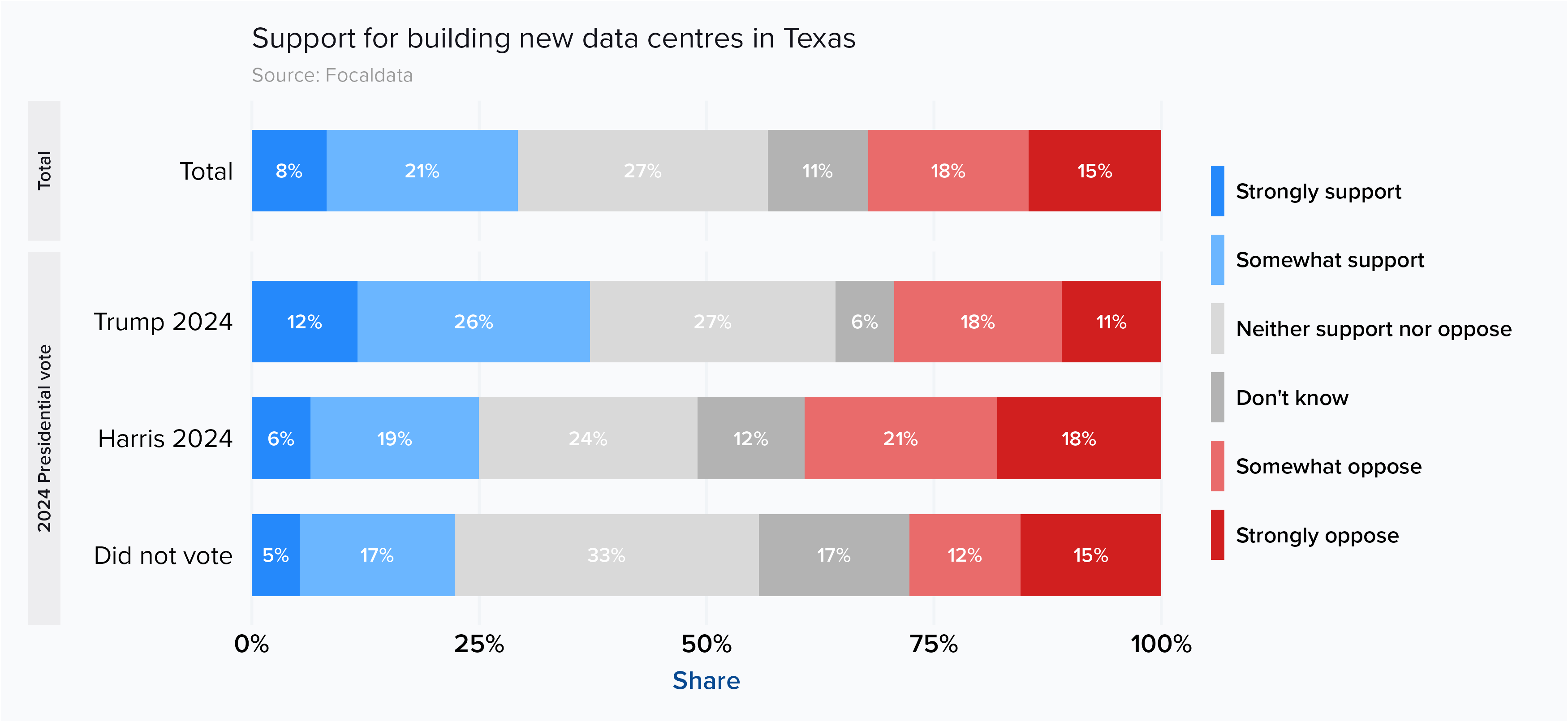
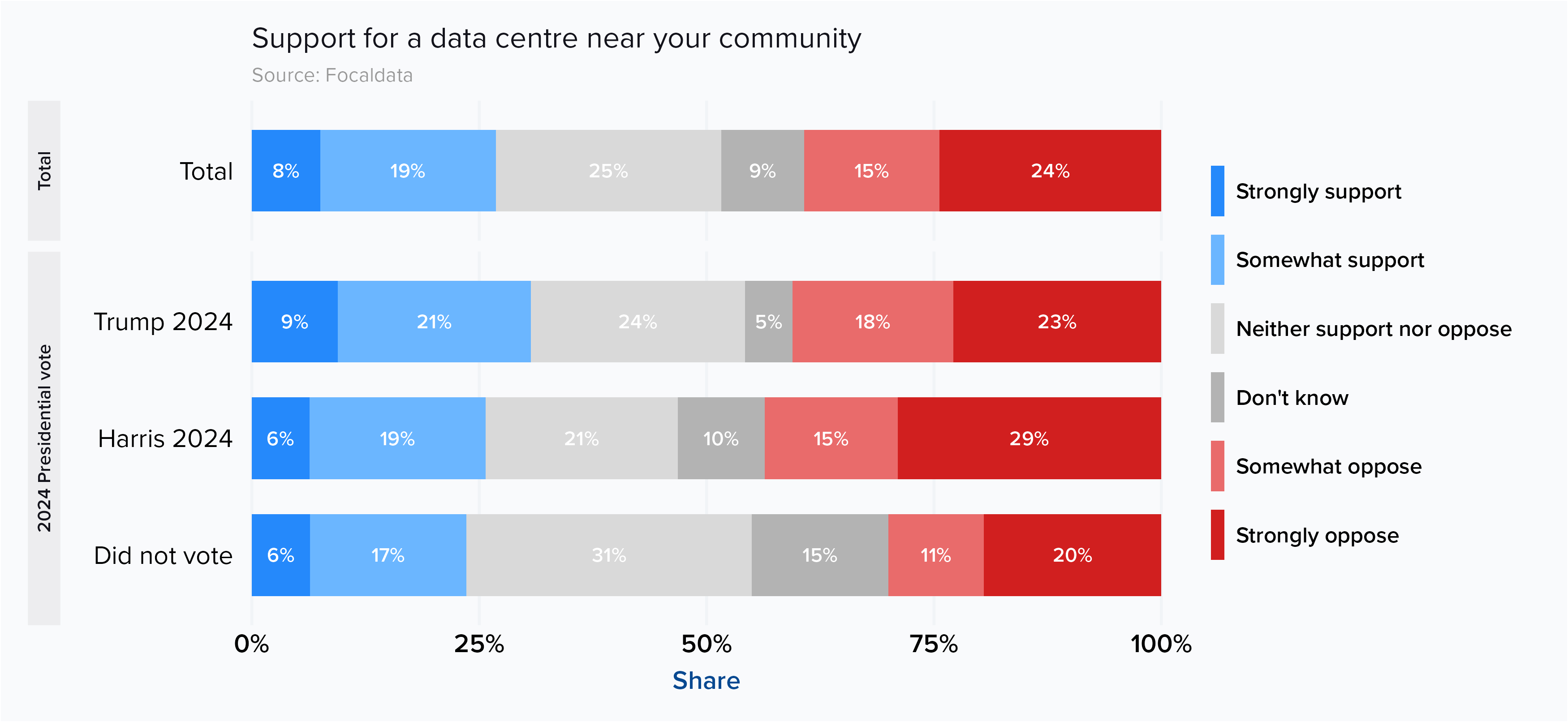
The first is what I call the proximity gap. Asked about building new data centers in Texas, the state is close to evenly divided, net minus 3, and Trump voters are actually in favor, net plus 8. Asked about a data center near your community, the same electorate moves to net minus 12, and Trump voters flip to minus 10. That is an eighteen-point swing among the buildout’s supposed base, produced by nothing except moving the project from the abstract to the local. Harris voters go from minus 14 to minus 18. Unaffiliated voters fall from minus 13 to minus 28.
Shot:
Chaser:
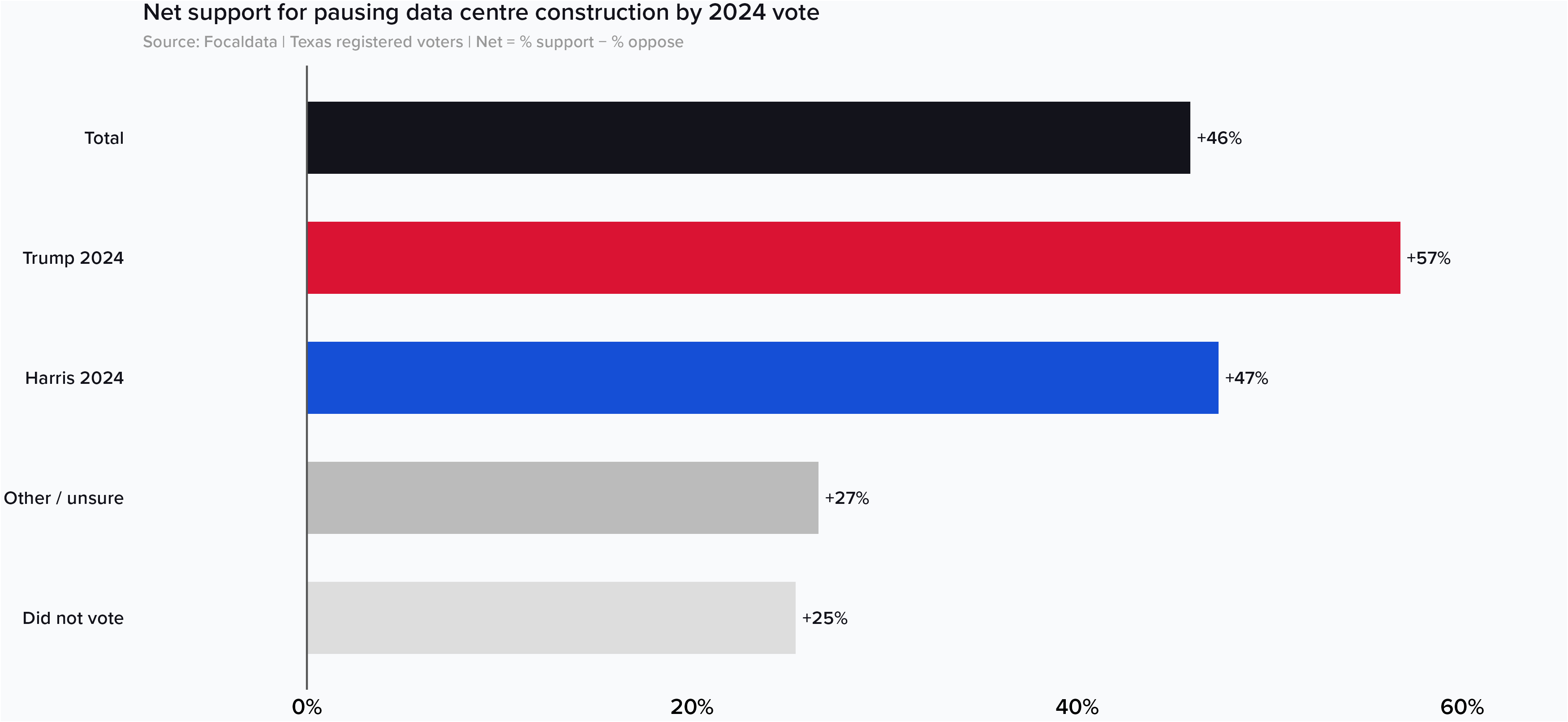
The second key finding is the moratorium appetite. We asked Texans how they felt about other counties pausing data center construction, the Hill County move. Net support: plus 46. Among Trump voters it is plus 57, higher than among Harris voters at plus 47.
In other words, in the reddest large state in America, which hosts the greatest concentration of projects on earth, the voters most supportive of freezing construction are the ones the industry has been counting on as its base.
So statewide sentiment says the market is fine but local sentiment says every individual site is the devil. A developer reading state-level polling, or worse, reading nothing, would naturally see a green light that does not exist at any actual location. The sums detailed above is what driving through that phantom green light has cost the sector so far, at a moment when the only people acting on these public setiment numbers are county commissioners. The far more expensive moment arrives when professional politicians start reading them, and as Part V will show, that moment is here.
Part V: The Uncontested Election
Everything so far has been a development story, told in permits and polling. This part is about the moment it stops being one, because there is a fixed date on the calendar, the first Tuesday of November, when data centers stops being an investment strategy and starts being an instrument for acquiring public office.
Start with what kind of issue this actually is, because the industry keeps misfiling it. Data centers poll like a cost-of-living issue, and they poll that way because voters experience them as one. When Gallup asked opponents why they object, the answers were water, energy, pollution and bills. Heatmap’s polling finds more than half of Americans hold data centers largely responsible for rising electricity prices. Marquette’s national survey finds 71% say the costs outweigh the benefits. Whatever the engineering truth of any individual project, the voter has already categorized the asset class: it is the thing making life more expensive and the reason they can’t get their kid a new toy for Christmas. Make no mistake: cost of living is the master issue of this electoral cycle, the frame through which every campaign in the country is being built.
Local officials have started losing their jobs over data centers. Festus, Missouri recalled half its city council over a six-billion-dollar proposal. Warrenton, Virginia voted out its entire council after it approved an Amazon facility. A New Jersey official told Newsweek: “Do I think that the data center vote cost me the election? Yes I do.”
Every politician in America can read an obituary. The lesson being absorbed at the county level right now is that there are careers to be lost by approving these projects and careers to be made by stopping them.
Statewide campaigns are building platforms on this issue as I write this essay. In Wisconsin, all seven prominent Democratic candidates for governor back data center regulation or an outright moratorium. In Pennsylvania, the sitting Democratic governor demands that data centers bring their own power while his Republican challenger tries to outflank him with a full development pause. A Republican candidate for governor of Florida has pledged to ban them in all 67 counties. Illinois has paused its tax incentives. A Republican senator from Missouri has filed a bring-your-own-power bill in Washington while a socialist senator from Vermont campaigns for a national moratorium. Notice what is missing from this list. A party line. The issue is being claimed simultaneously from the left as corporate greed and from the right as ratepayer protection. Both parties’ candidates are converging on the same position because both parties’ pollsters are reading the same crosstabs.
Next prediction. I believe data centers run as a top issue in the November midterms, packaged inside cost of living, and I believe this cycle produces the first national politician who makes the issue theirs. When that happens, a mechanism activates that the industry has never faced before, so it is worth spelling out slowly.
A national figure claims the issue. Every local zoning fight becomes evidence for a national argument, which means every contested site arrives with a press corps attached. The cost of a botched hearing stops being a nine-month delay and becomes a news cycle with your company’s name in the chyron. And that footage does not expire. It plays again at the next hearing, in the next county, presented by the next opposition group as proof of what your company does to communities like their’s. Local failures currently die locally. After the looming nationalization of this issue, every failure is permanent, portable and in the training data of every future fight.
Also note the asymmetry in who benefits from this. For the opposition, nationalization is pure oxygen. National attention fills the petition lists, fills the fundraising pages and recruits the next 400 local groups at zero cost. The machine from Part III is literally built to metabolize attention. For a developer, the same attention flows straight into the discount rate. Lenders reprice, insurers reprice, counterparties add contingencies, and projects that pencilled at the old level of political risk stop pencilling. An opponent that gets stronger from the fight while you get weaker from it is the definition of a losing position.
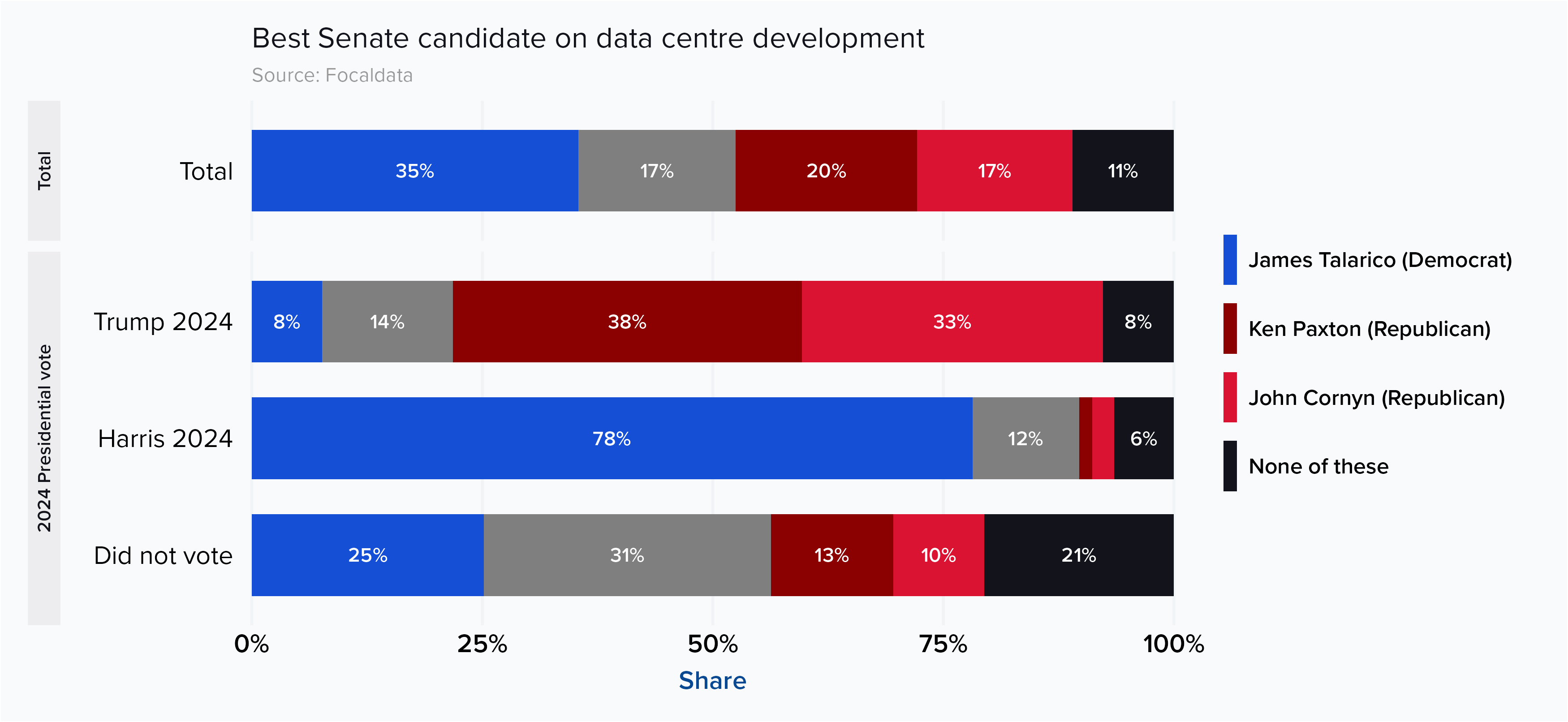
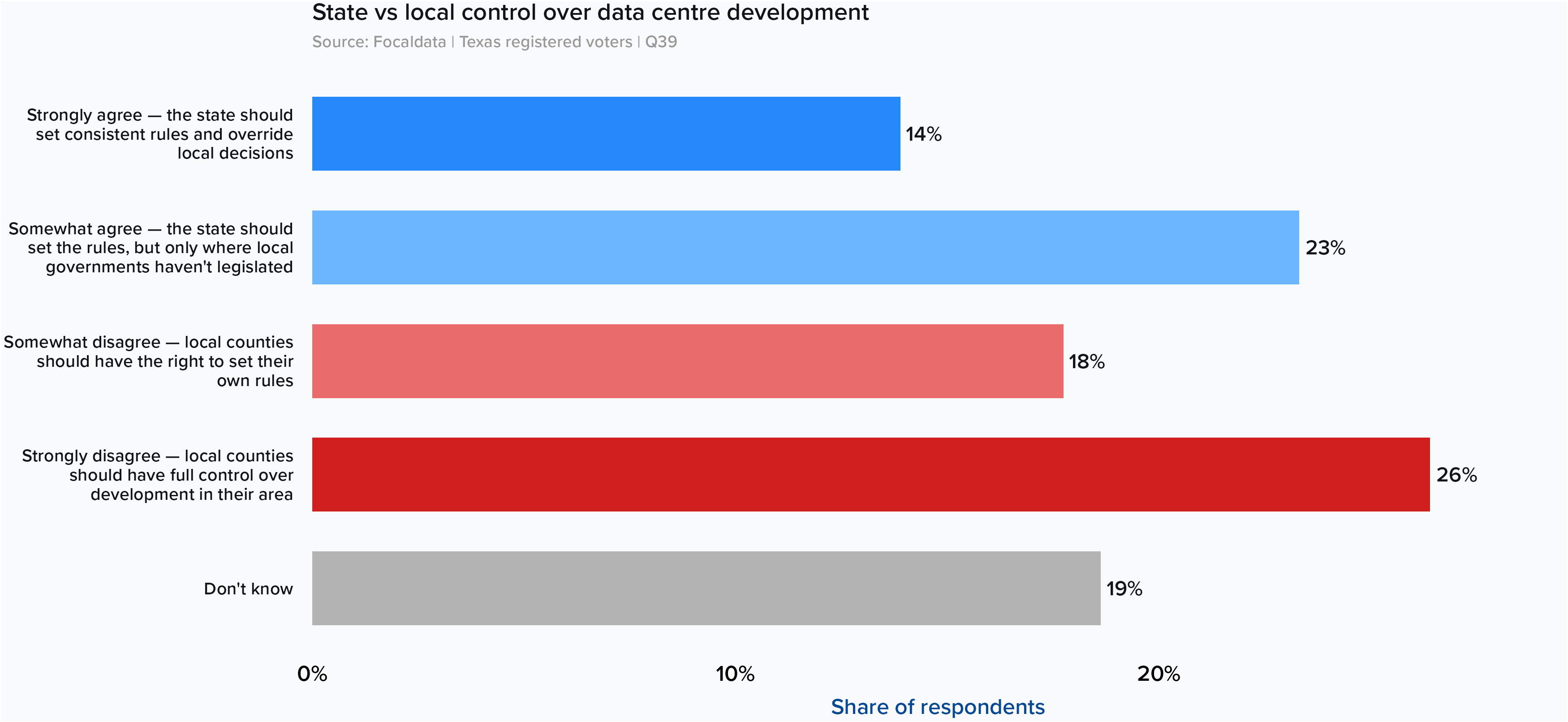
Our Texas data shows how far down the ballot the sorting has already reached. We asked Texans which Senate candidate would best handle data center development, and they had answers: 35% picked the Democrat, 20 and 17% split between the two Republicans, and the preferences sorted cleanly by 2024 vote. The question did not confuse them, because the issue has already entered their candidate-choice architecture, in the state with more projects than any other. And for anyone in the industry hoping state capitals will simply preempt the troublesome counties, the voters have a view on that too: asked who should control data center development, 44% of Texans side with local counties against 37% for state authority. The Austin-will-fix-it escape hatch is underwater with the very electorate that would have to forgive its use.
Between now and November, every competitive campaign in a state with a pipeline will discover what the candidates above have discovered. By election day, the anti side of this issue will be established in essentially every contested geography across the country. Community sentiment, once set, costs an order of magnitude more to reverse than it would have cost to shape, because after November the developer is no longer filling a blank; the developer is arguing with a position the community voted for. This is one big game of who gets there first.
This whole essay exists to deliver one message: the firms with no basic community-building infrastructure in place are going to get absolutely steamrolled when this flips in November.
The one thing this part has not told you is why any of it is survivable. That is Part VI.
Part VI: The Tiger is Paper.
Congratulations for making it through the first five parts of dread. Now for good news: the opposition is far softer than its headline numbers, and the softness sits in specific, measurable places.
Yes, the 71% opposition is real. But it is also, in large part, a coalition of the convinced and the merely defaulted, people who absorbed one scary fact about water or bills from the only side talking to them. This can be fixed.
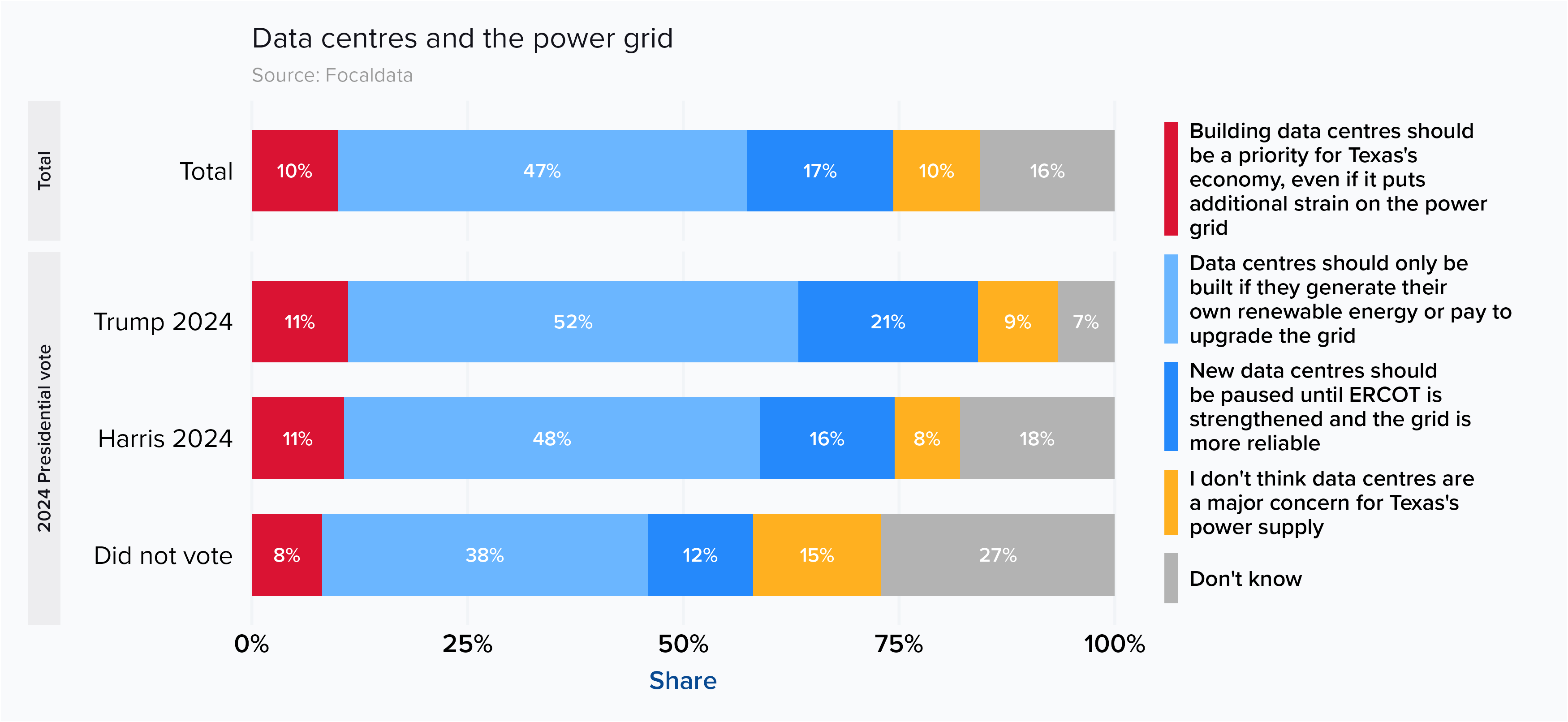
Start with the finding I consider the most important in our Texas data. We asked Texans directly what should happen with data centers and the grid, and gave them the full menu. Only 17% want new data centers paused until ERCOT (Electric Reliability Council of Texas) is strengthened. Only 10% say build them even if it strains the grid. And 47%, the outright plurality of the state, say data centers should be built if they generate their own renewable energy or pay to upgrade the grid. Translation: in the most contested data center state in America, the prohibitionists are a sixth of the electorate, and the largest bloc by far is holding out terms.
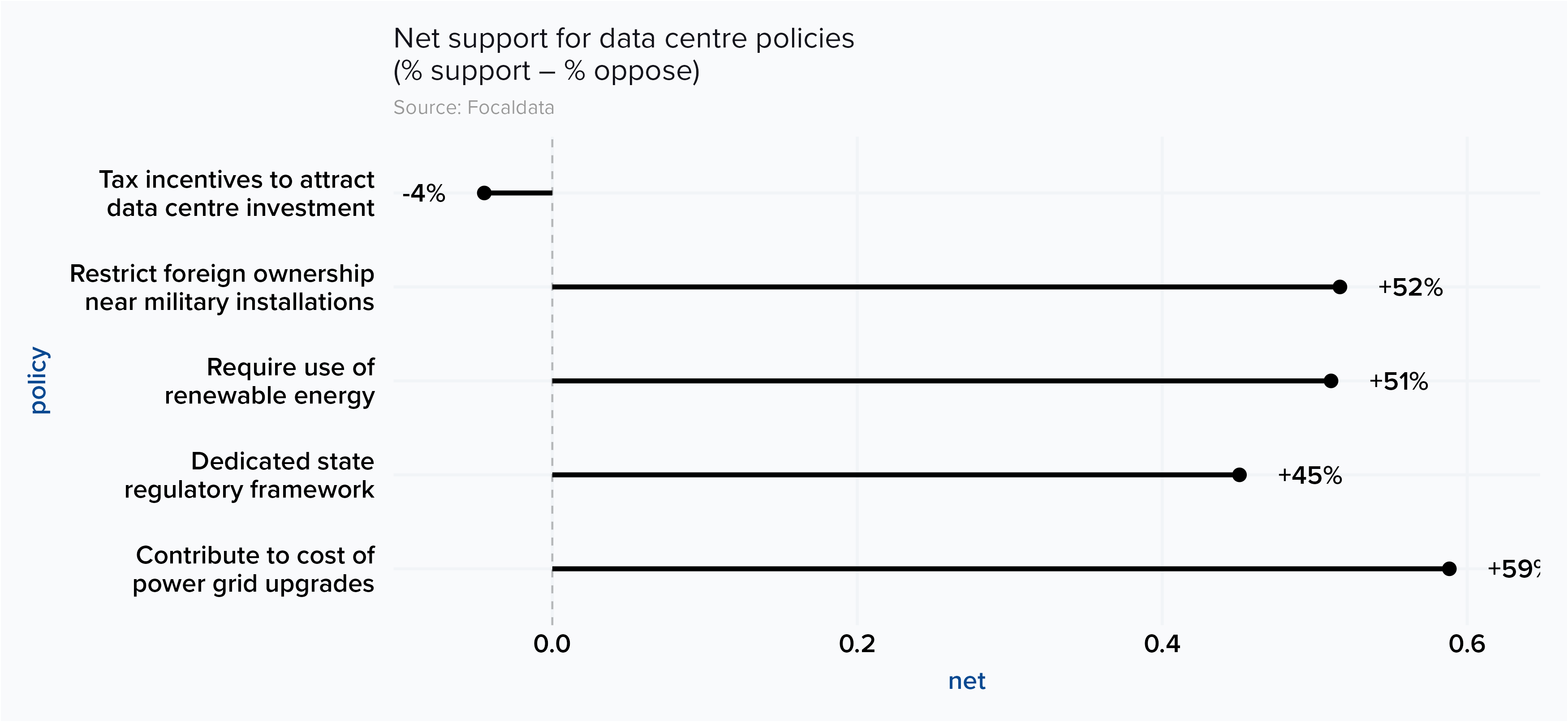
The policy questions double down on this. Requiring data centers to contribute to grid upgrade costs polls at net plus 59. Requiring renewable energy, plus 51. Restricting foreign ownership near military installations, plus 52. A dedicated state regulatory framework, plus 45. On the other end of the spectrum, tax incentives to attract data center investment sit at net minus 4, and at minus 30 among unaffiliated voters. Texans are largely pro-rules and anti-subsidy. They will accept the buildout but they refuse to pay for the privilege. Break the grid question out by 2024 vote and the picture sharpens further: among Trump voters, making developers pay for grid upgrades polls at plus 70. The single most Republican demand in our entire survey is that the industry cover its own costs.
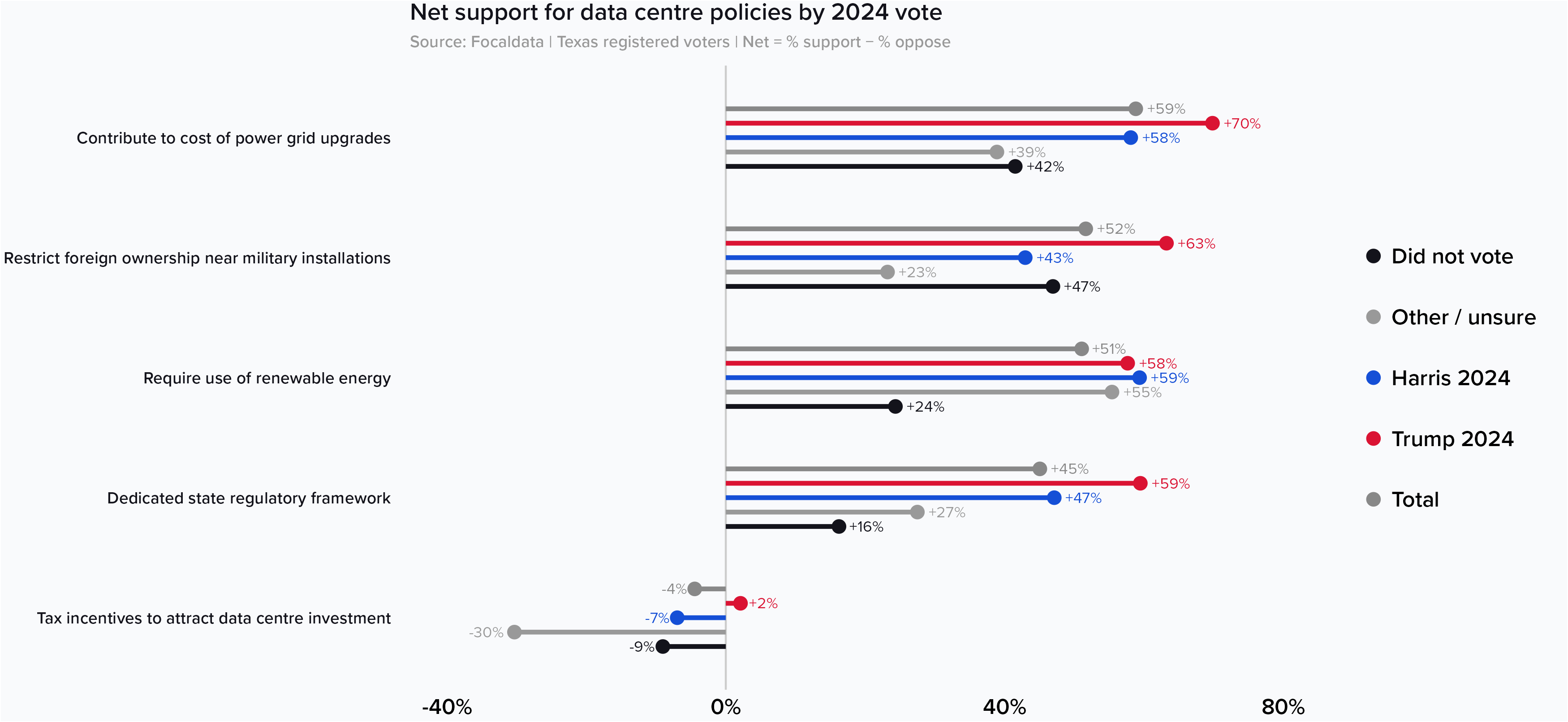
The diagnosis writes itself. The electorate aren’t refusing, they’re negotiating. And it’s a negotiation to which the industry has simply not shown up.
Now cosider the proximity gap from Part IV, because it tells you the second diagnosis. The same Trump voter who is plus 8 on the Texas buildout is minus 10 when the project lands near his home. Ideology does not invert with distance. Unaddressed local risk does.
Solution: address that risk with clear answers.
The audience willing to listen to those answers is still absolutely massive. After nine months of collapse, roughly a third of Texans are uncommitted on a data center near their community, answering neither or don’t know. The fight for the middle has barely been joined.
What would the answers need to address? The opposition’s own voice is the best guide. When Gallup asked opponents in an open-ended follow-up why they object, they said water, 18%. Energy, 18%. Pollution, including noise, 16%. Higher bills, 15%. Every single item is answerable with facility design and binding commitments. Closed-loop cooling answers the water number. Behind-the-meter generation answers the energy number. Enforceable bill protection answers the cost number. These are information failures and design failures, and both kinds are correctable.
The residual core of opponents for whom no concession works, the people who believe none of this should be built at all, exists in every local fight I have worked. It is loud. It is also small, and the correct strategy is containment rather than conversion. Meanwhile the raw material for a pro coalition is already lying on the ground: 45% of Texans name job creation as a benefit of data centers and 35% name tax revenue for local schools and communities. Supporters exist. They are silent because nobody has ever organized them, and silence reads as absence in a hearing room.
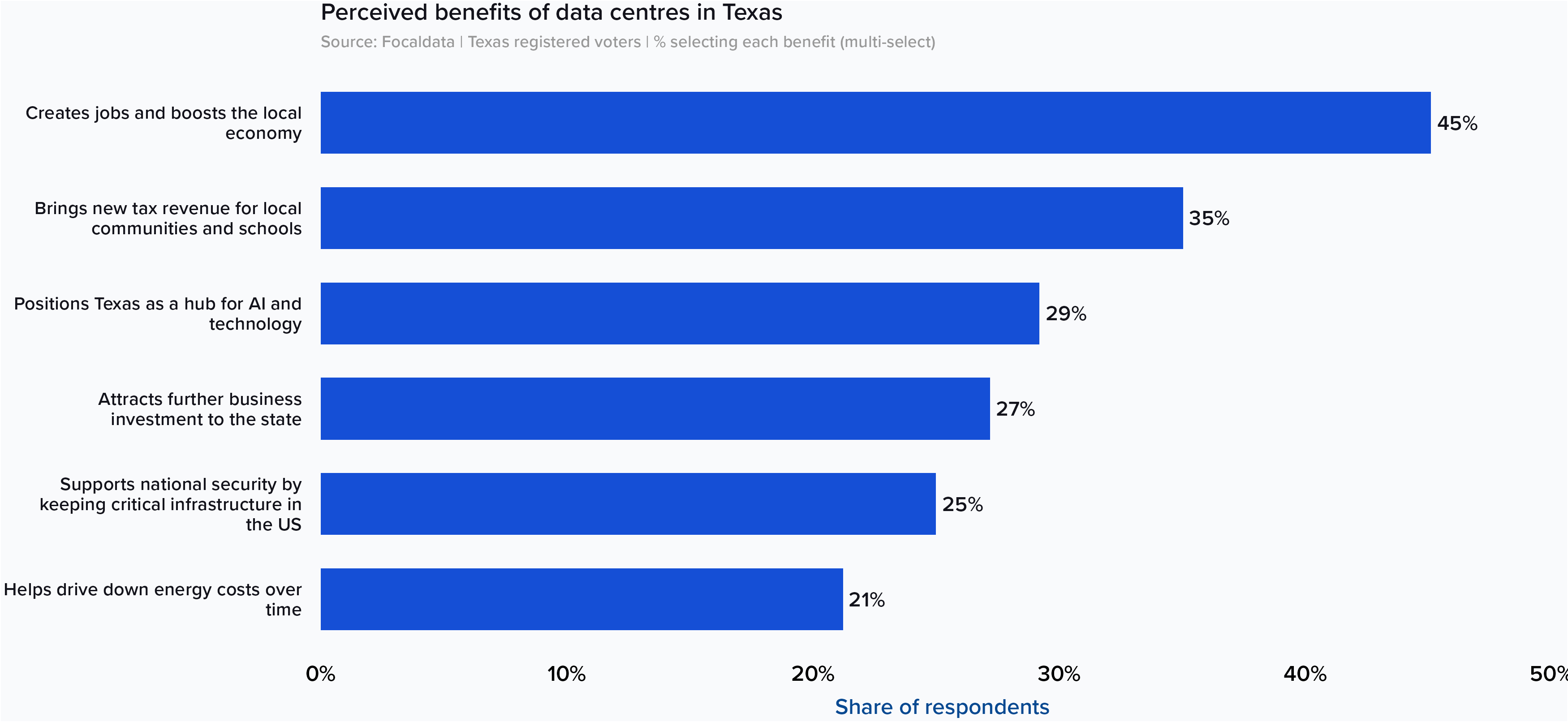
Do persuasion facts actually move people, or is that just consultant’s cope? The public evidence says they move. In Heatmap’s September 2025 message testing, the claim that data centers create high-paying construction and operations jobs polled at plus 26 net convincing. The catch is that the opposition’s messages currently hit harder, with the bills argument at plus 46 and the water argument at plus 34. Notice what that asymmetry is made of. Both sides possess persuasive facts. One side has been delivering its facts to the low-information majority for nine months while the other sent a press release to datacenterdynamics.com. That gap comes from sequencing and repetition, and sequencing can be changed.
This is testable against my own record: across the sites I have worked on, contested projects that ran aggressive methodologies such as sentiment mapping, segment-level messaging and concession design before the decisive hearing have ended in acceptance more than 80% of the time. The methodologies behind that number is the subject of the next chapter.
One more finding. The single cheapest variable in the whole fight is brand awareness. Texans’ net comfort with Google owning a local data center is plus 33. Microsoft, plus 25. Amazon Web Services, plus 20. Meta scrapes by at plus 1, and xAI sits at minus 12. TikTok polls at minus 41, and a company backed by the Chinese or Saudi government at minus 52. The trust discount starts before a word is spoken, and it varies by 85 points depending on whose logo is on the fence. Note also what the foreign-ownership numbers hand to American developers: the most potent security argument in the survey, restrictions on foreign-controlled facilities near military sites at plus 52 overall and plus 63 among Trump voters, is an argument only the domestic industry can make. And almost nobody makes it.
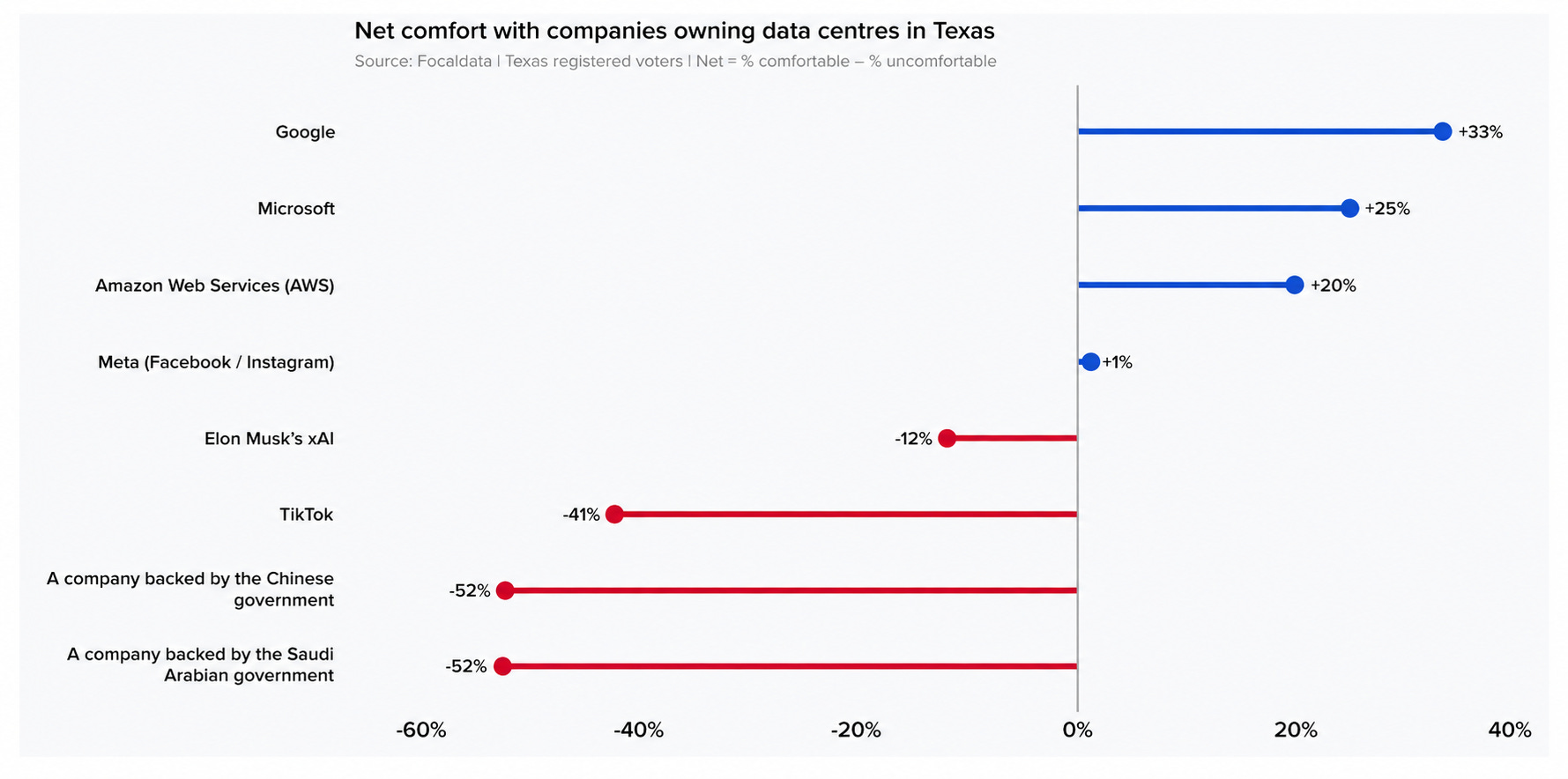
So the tiger is paper. A sixth of the electorate wants prohibition, a third is unclaimed, and the plurality is waiting for an offer that matches terms they have already stated. But paper tigers still win wars against opponents who never show up to the field of play, and every month of absence hardens soft opposition into the firm kind. The concrete is setting, and it sets permanently around election day. The question is whether anyone on the building side owns instruments precise enough to find the soft places while they are still soft. Those instruments exist. I use them for a living, and Part VII is an honest tour of how they work.
Part VII: The Counter-Machine
None of this section is exotic. Any figures in this section are representative examples, included to show the shape of the output rather than findings from a live study.
Begin with the problem that defeats ordinary polling. A respectable national survey of 20,000 people sounds enormous until you ask it about one rural county, at which point you discover it contains perhaps thirty respondents there, a sample from which you can conclude nothing. Since the buildout’s fate is decided precisely in such counties, conventional polling enjoyed by the industry is structurally blind exactly where the war is. The workaround is a technique called MRP, multilevel regression with post-stratification. Instead of treating each county as its own tiny poll, you use the entire national sample to model how opinion varies with the characteristics of people and places: age, tenure, education, housing type, local industry, distance from existing infrastructure, dozens more. That model is then run against the census, which tells you exactly how many people of each type live in every precinct in the country. The output is a statistically disciplined estimate of opinion for every small geography in a state, including ones where the raw poll spoke to five people. British readers will remember this as the technique that correctly called dozens of individual constituencies off a single national poll in the 2017 election while conventional polling missed the result, and it descends from the same family of methods the Vote Leave data operation used to find persuadable voters the traditional campaigns were ignoring. The payoff for a developer is blunt. A sentiment map of an entire state, resolved to the precinct, before a single acre is optioned. Community risk priced into the acquisition alongside interconnection risk and water rights, instead of discovered at the first hearing.
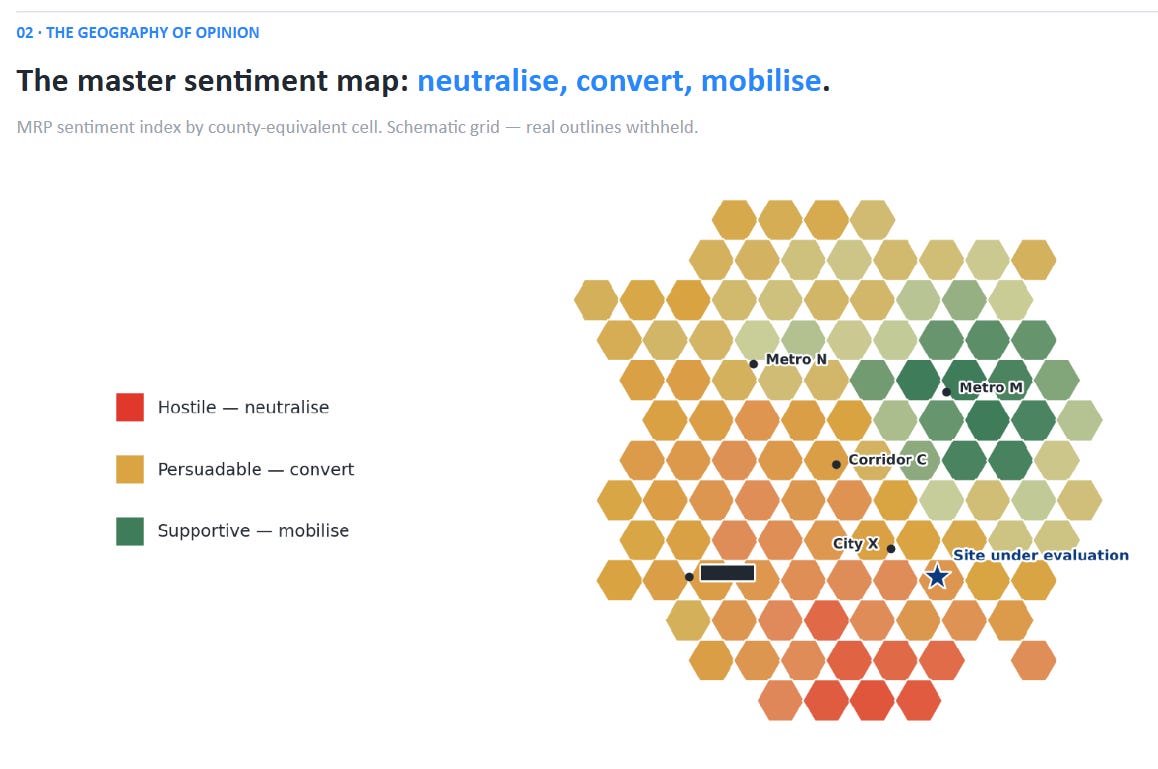
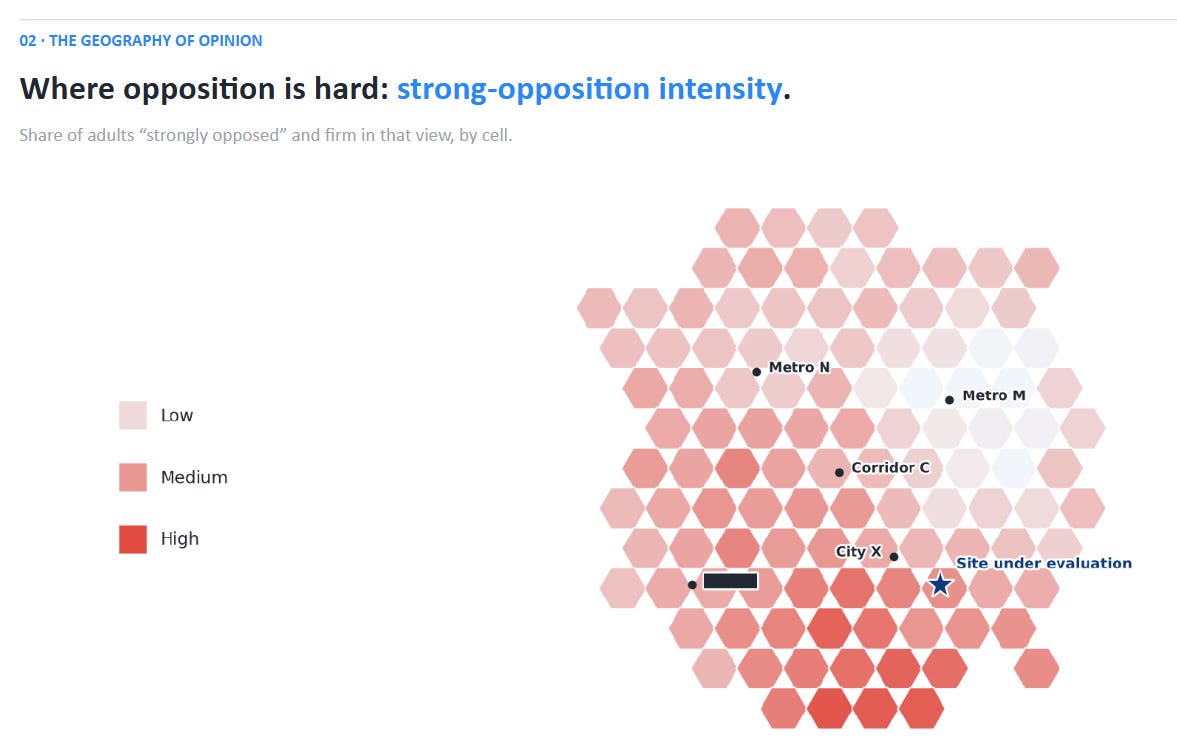
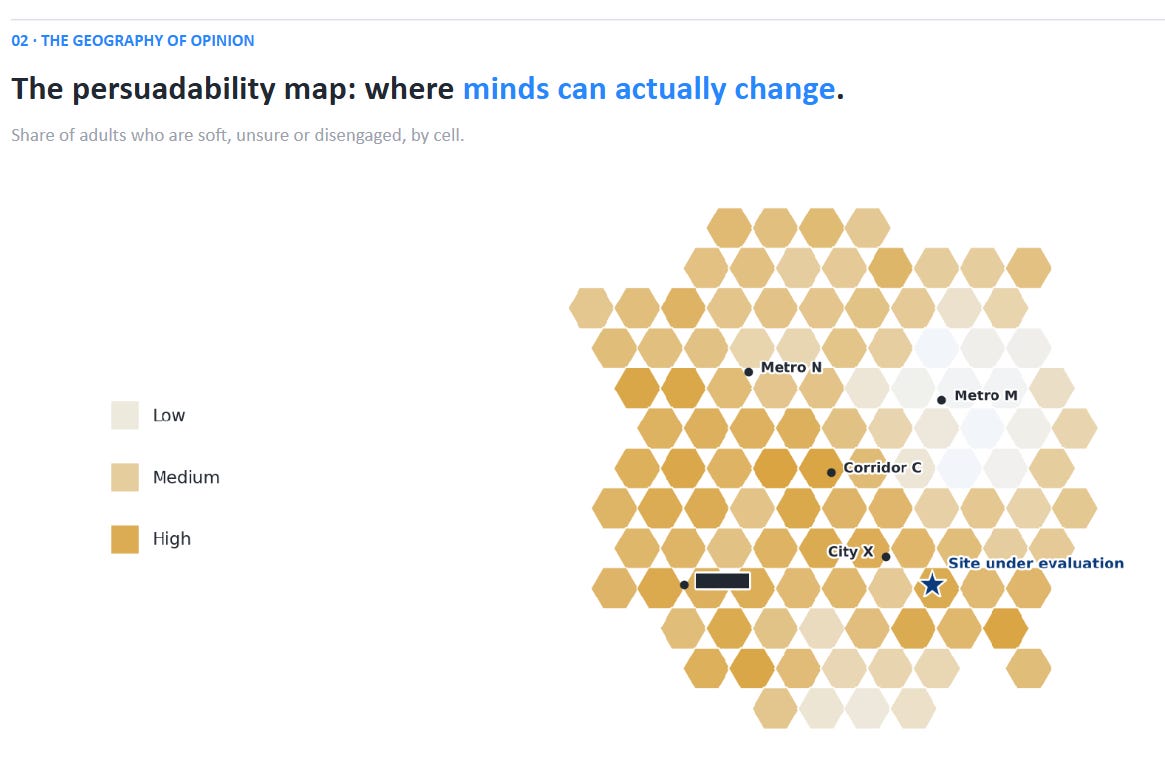
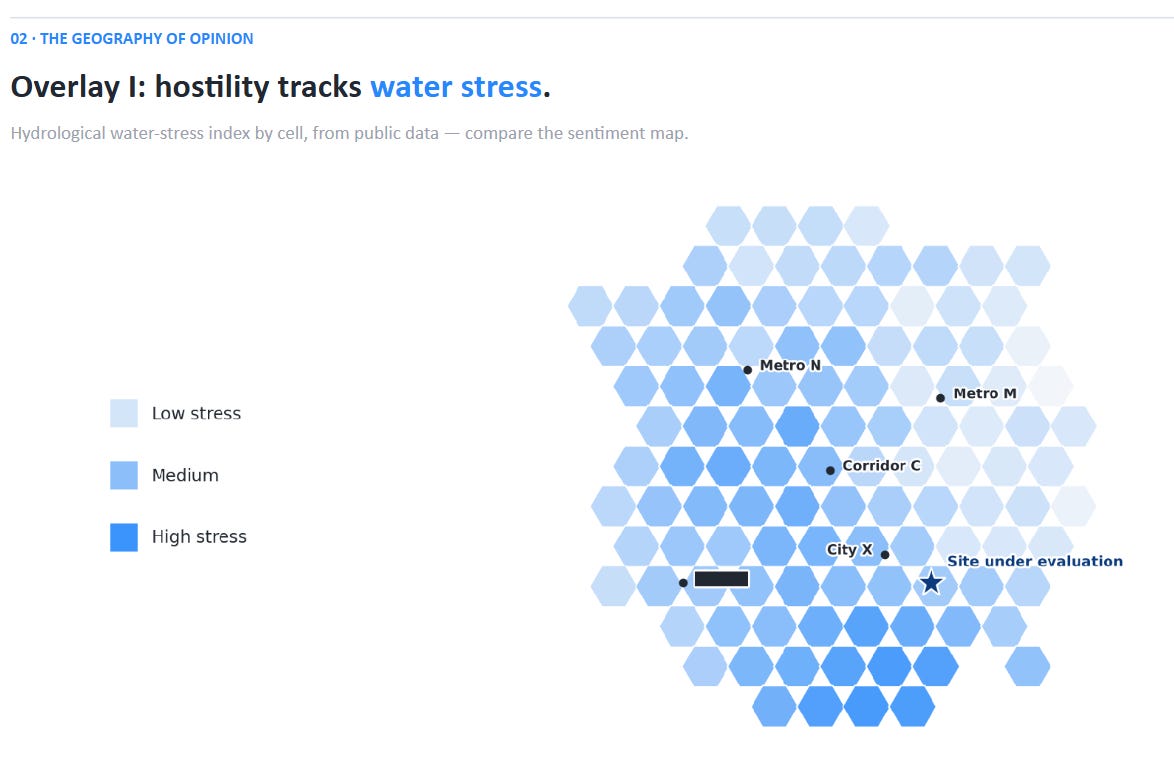
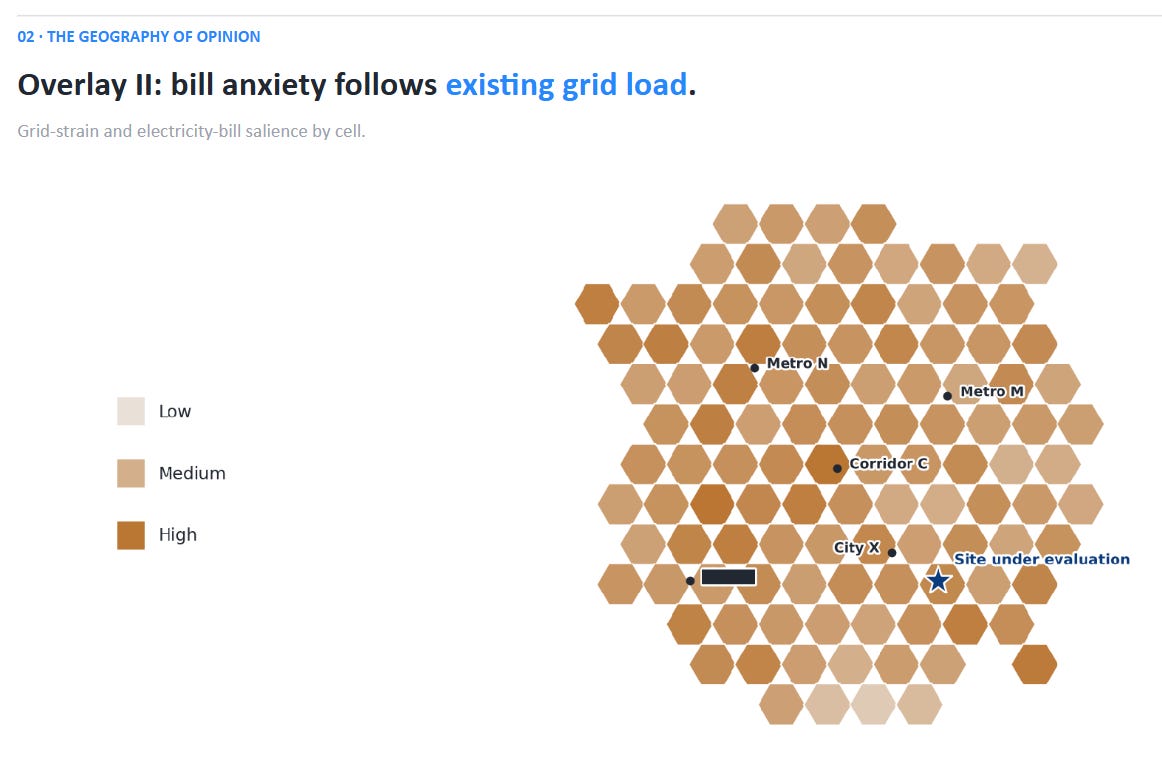
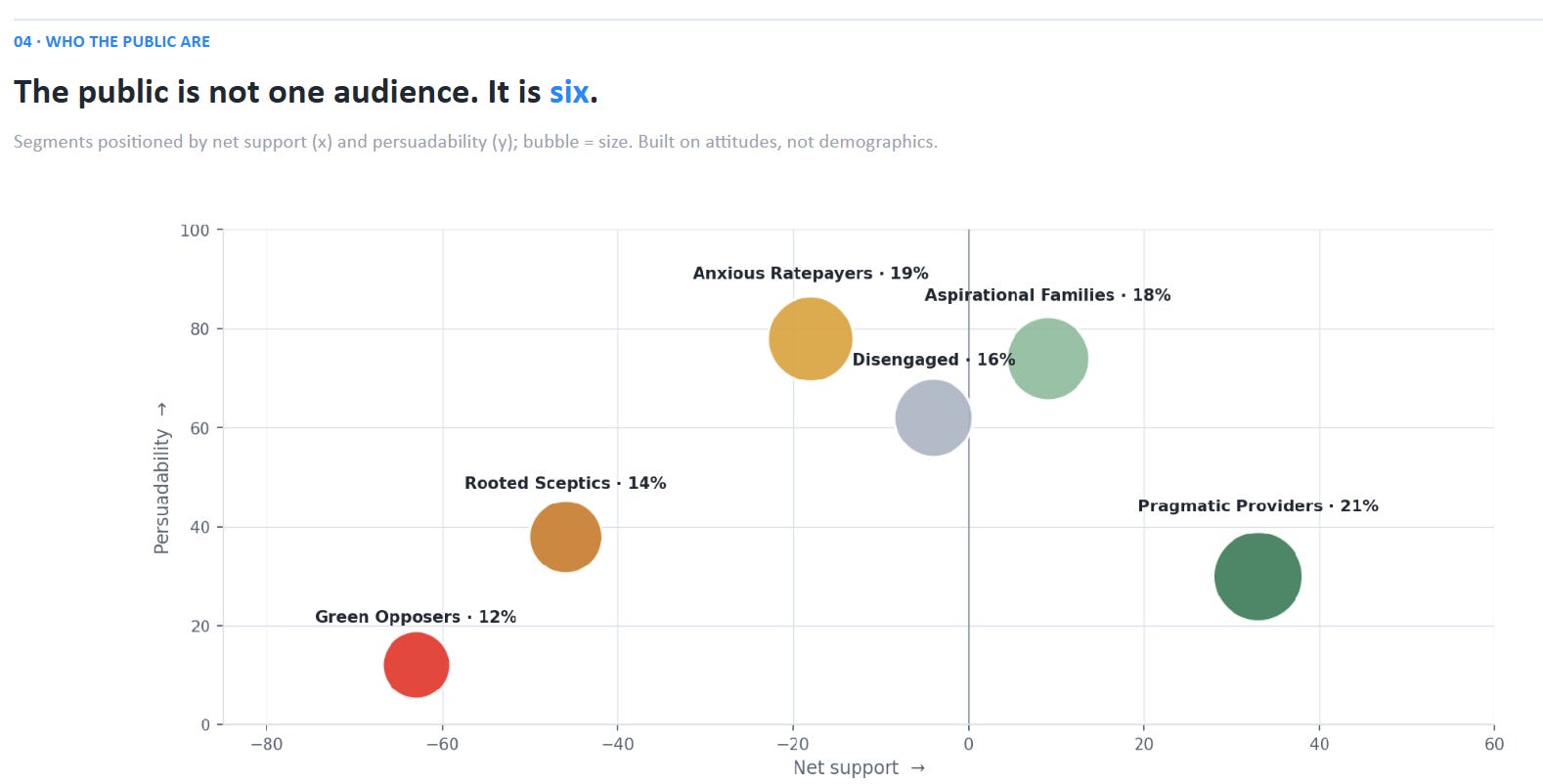
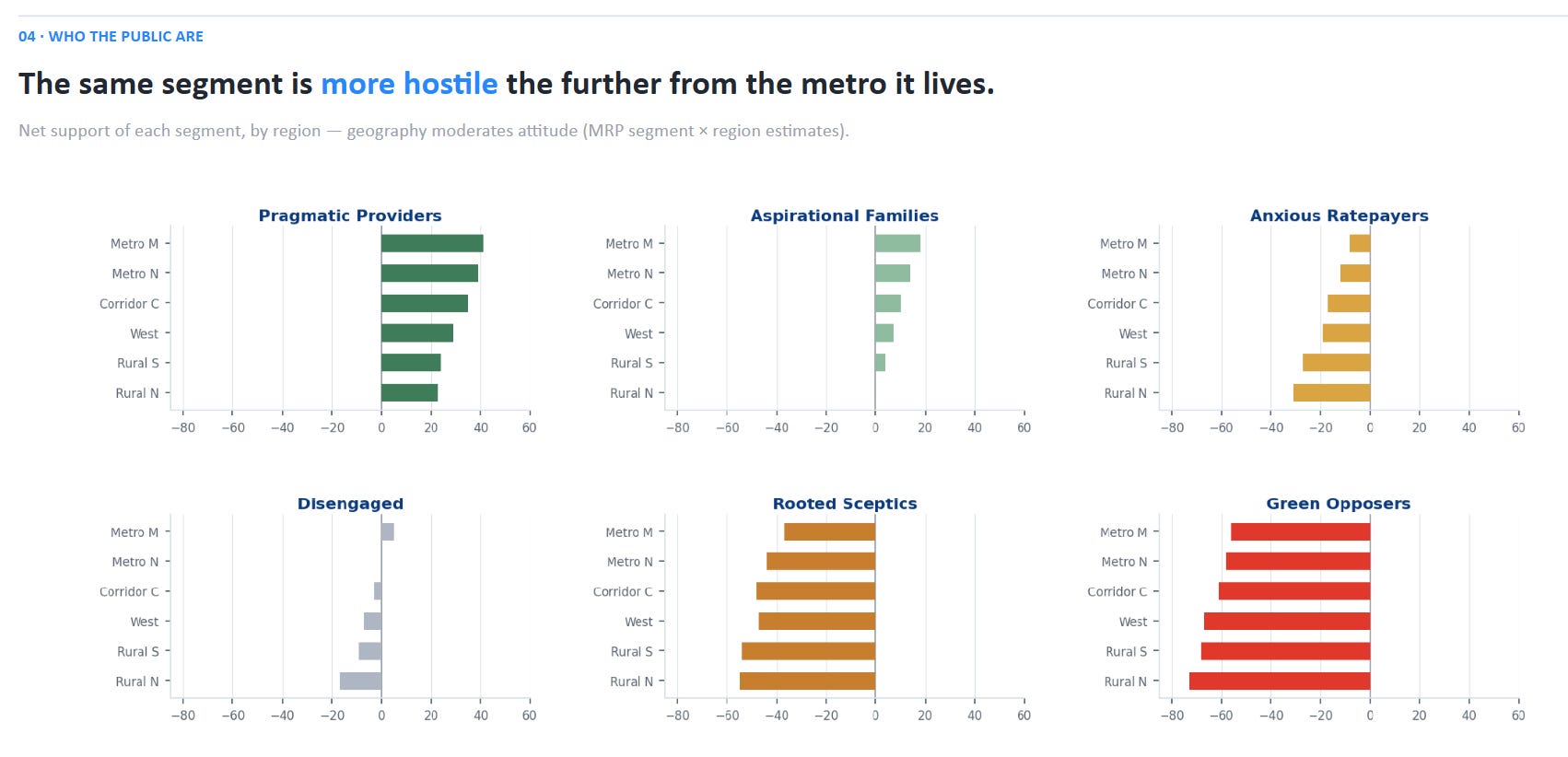
The maps tell you where. The next instrument tells you who. The single most common strategic error I see is segmenting an audience by demographics, as if age and income were what determined a person’s view of a server hall. They are weak predictors. What matters is attitude, and attitudinal segments recur so reliably from state to state that I can sketch the cast in advance. There are jobs-first pragmatists, usually the only reliably favorable bloc, who lack nothing except a reason to speak up. There are benefit-conditional families who will trade acceptance for schools and roads. There are anxious ratepayers, the pivot of nearly every fight, whose entire relationship to the project runs through their utility bill and their well, and who read as opponents but are actually unanswered questions. There are place-protective sceptics who distrust outside developers on principle and respond to nothing except demonstrated permanence. There is a values-driven core opposed to the technology itself, for whom the honest strategy is containment rather than conversion, because no concession addresses an objection to existence. And there are the disengaged, who become whatever the first persuasive voice makes of them. Run one message at all of these audiences at once, which is what a standard community-relations campaign does for many of the developers I speak to, and you overspend on the immovable while underselling the movable. The segments need different offers and different facts.
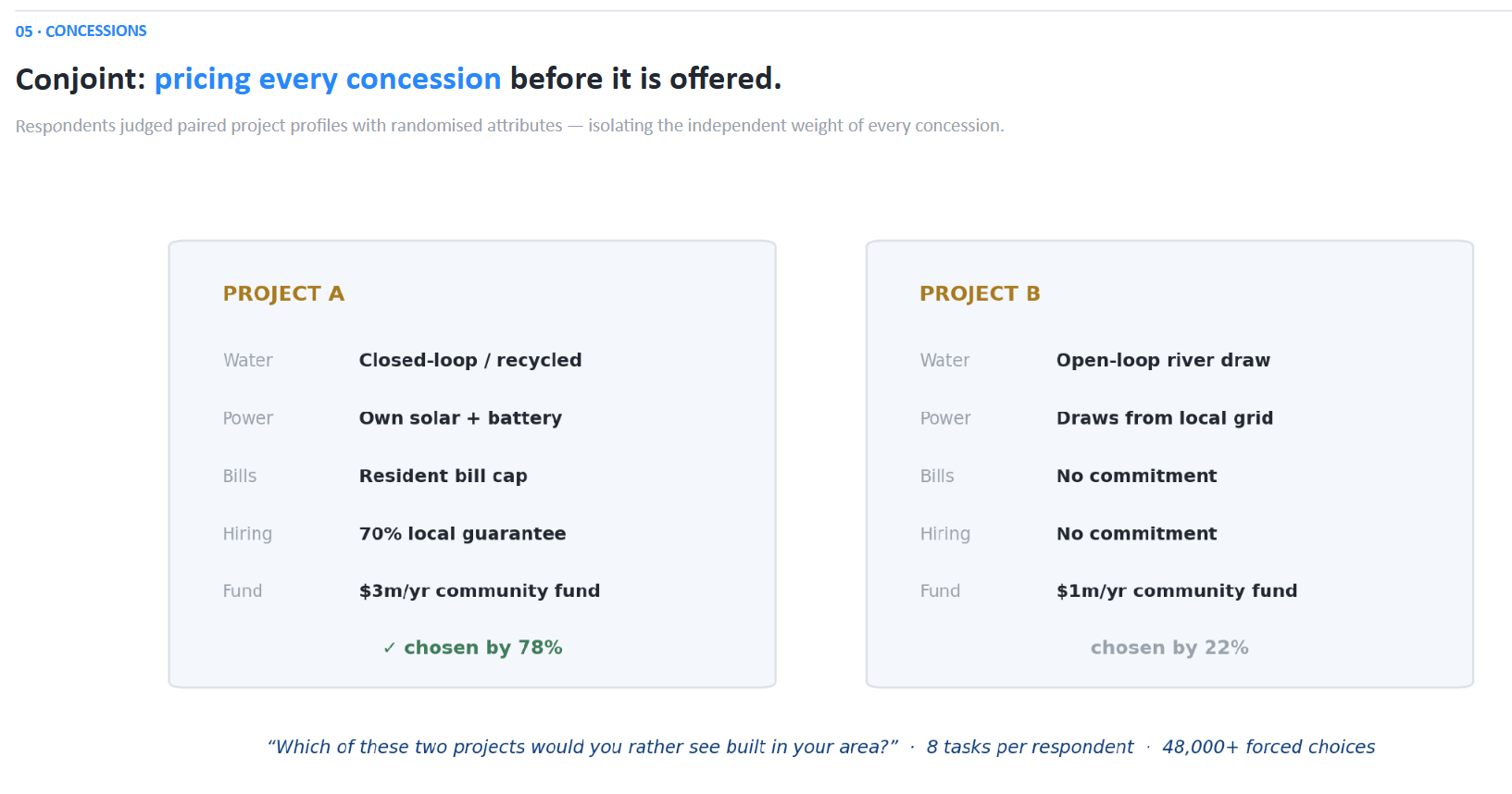
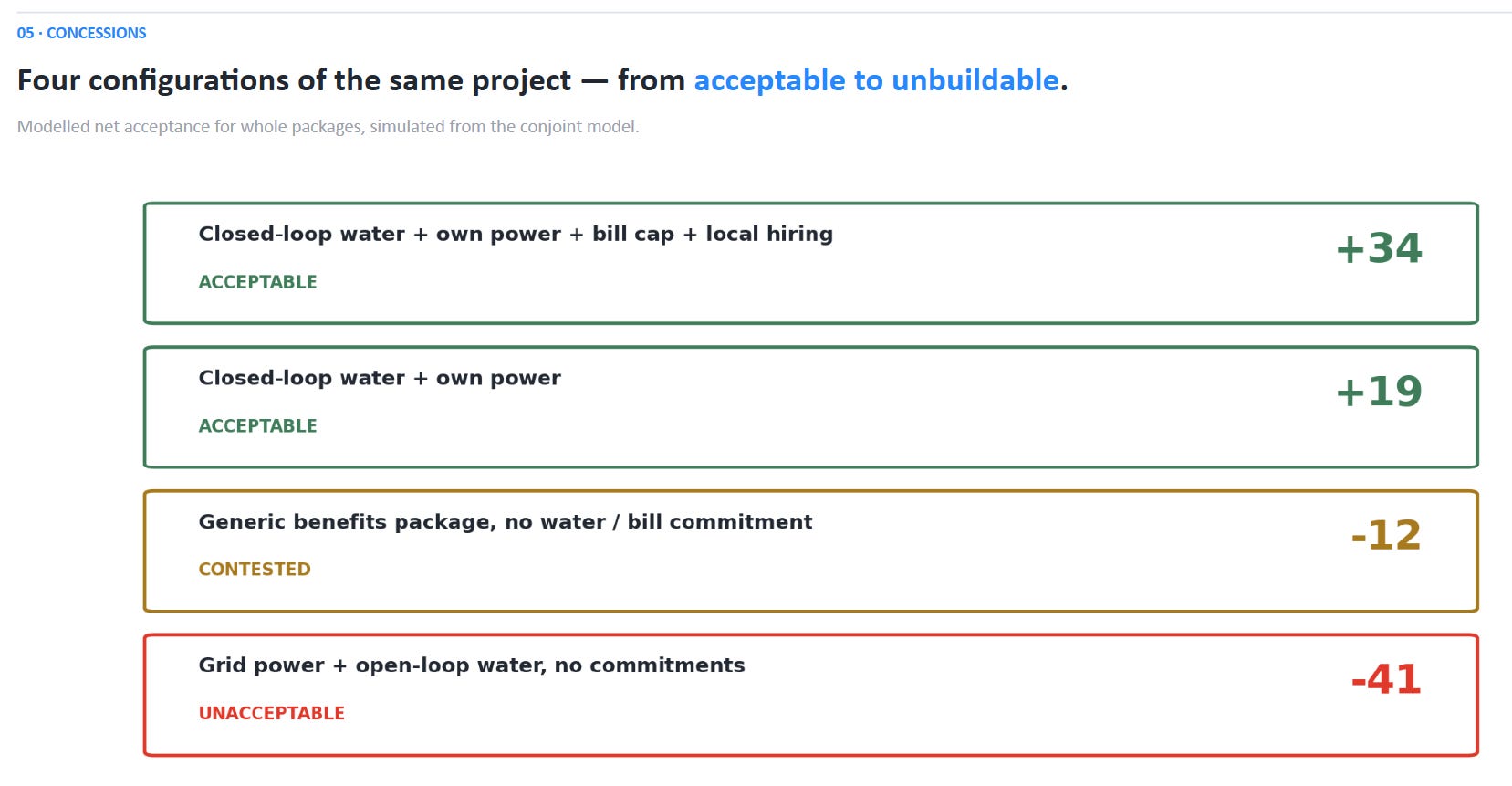
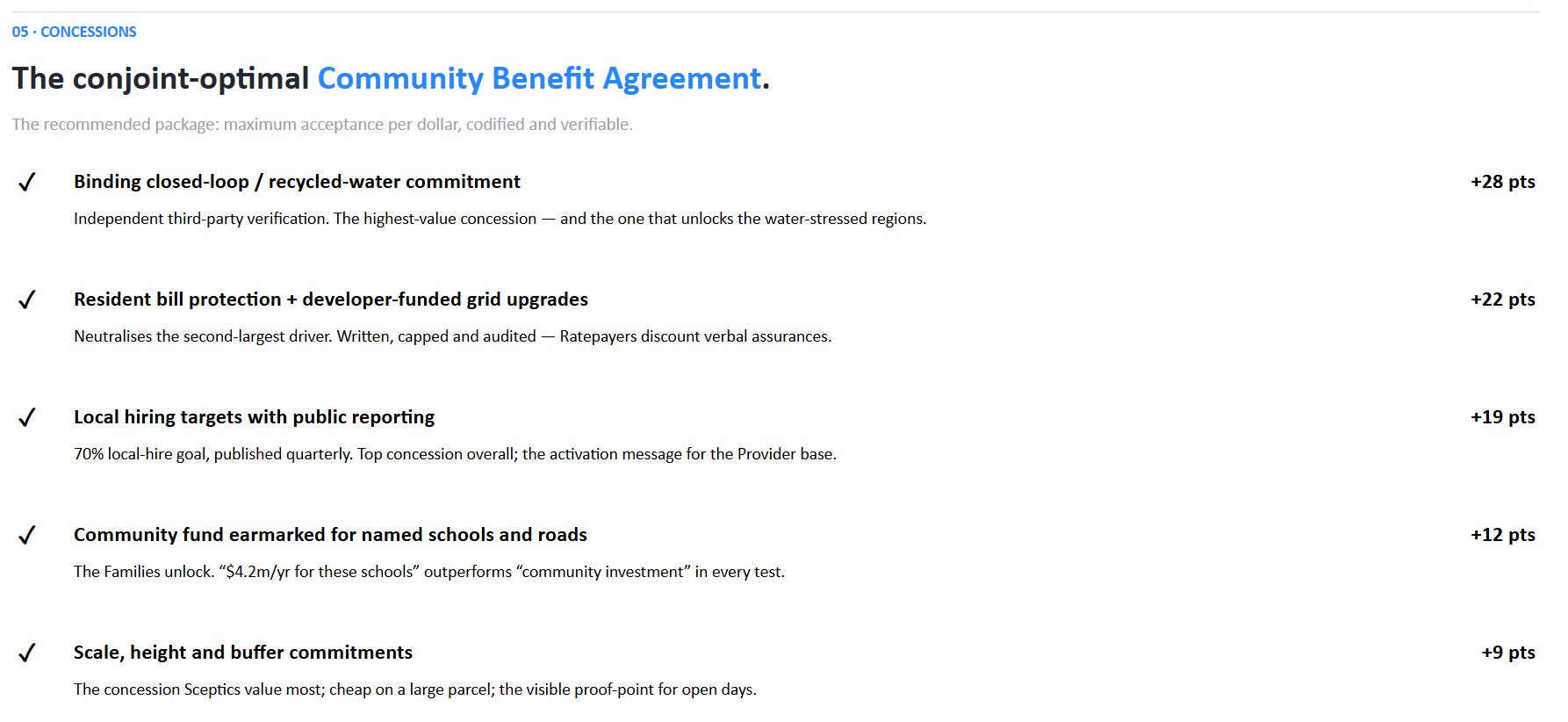
Which offers? That question also has an instrument. Conjoint analysis shows respondents pairs of hypothetical projects with randomized attributes, water arrangements, power sourcing, bill protections, hiring commitments, fund structures, and forces a choice, thousands of times across a sample. The statistics recover the independent weight each commitment carries in the decision. The practical translation is that the community benefit agreement stops being a gut-feeling negotiation and becomes a priced weapon of mass destruction: which package flips which precinct, and whether a hiring guarantee buys more acceptance per dollar than a community fund. Our Texas polling already shows the headline terms in that state’s market, own power and grid payment, sitting in plain sight at plus 51 and plus 59. Conjoint is how you find the precinct-level price beneath the headline.
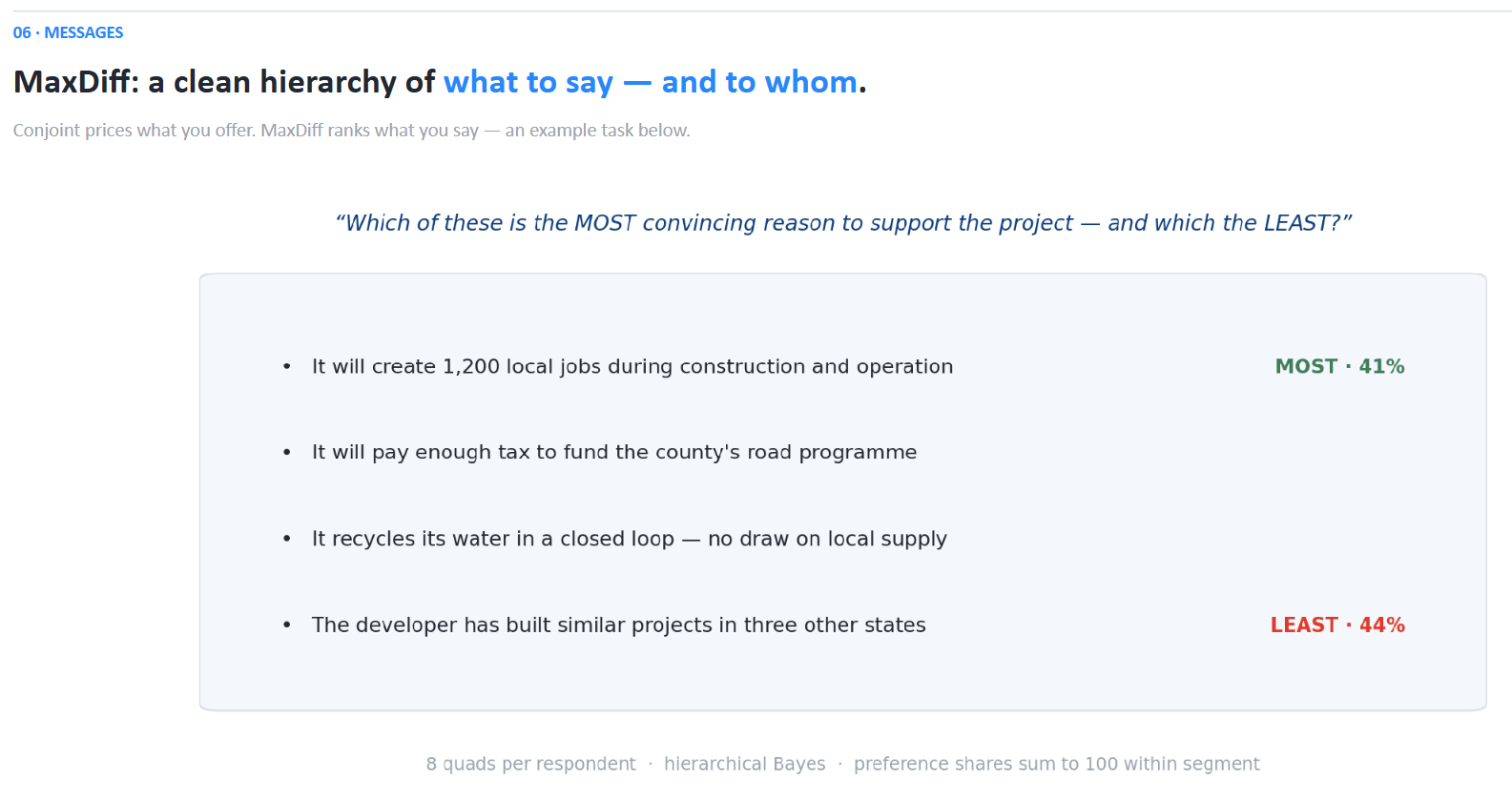
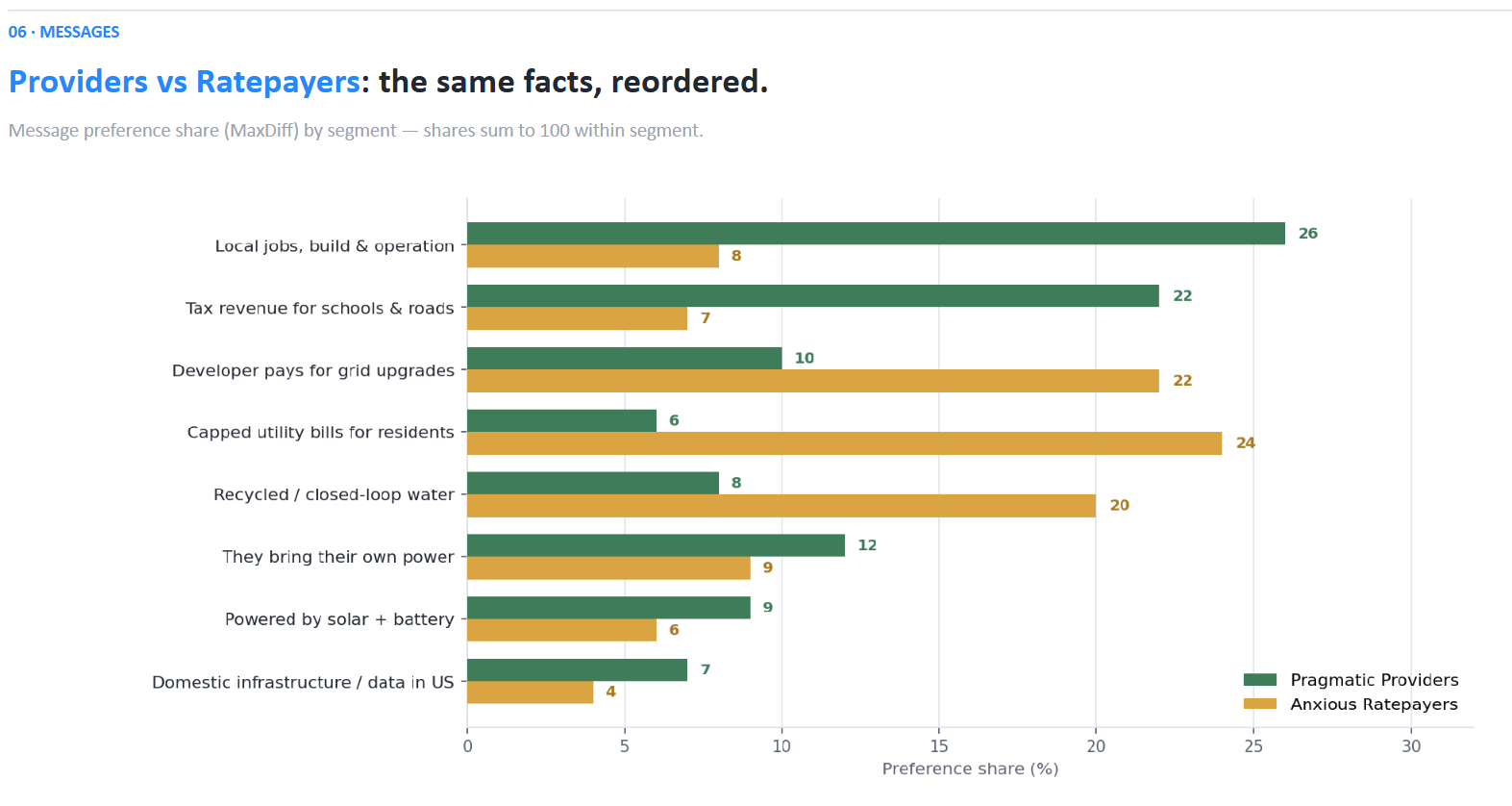
A related instrument, MaxDiff, does for messages what conjoint does for concessions. Respondents repeatedly pick the most and least convincing from small sets of factual claims, and the output is a ranked hierarchy of arguments for each segment. The finding that matters is that the same set of true facts reorders completely by audience. The jobs message that tops the ranking for pragmatists can land mid-table for ratepayers, whose ranking is led by bills and water. Open the town hall with jobs in front of a room of ratepayers and you have spent your strongest card on people it was never going to move, which is roughly the story of every failed benefits presentation I have reviewed.
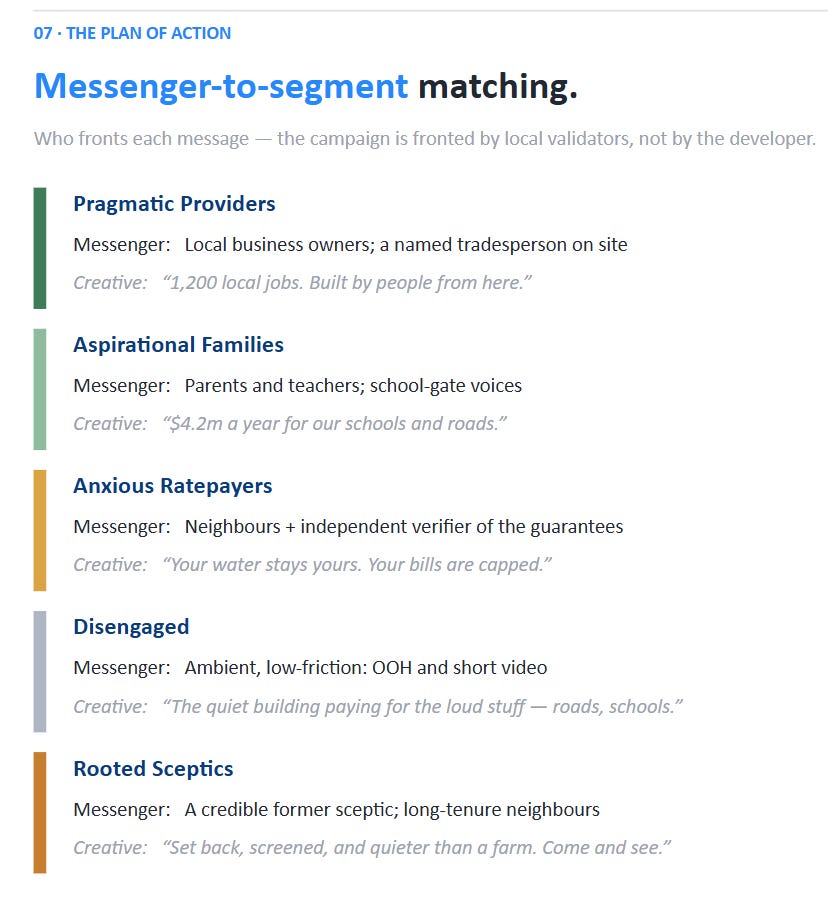
Then there is the question of who delivers the message, and it may be worth more than everything above depending on the site. Nobody believes the developer. In every local persuasion study I have seen, the company spokesperson and the paid advertisement sit at the bottom of the trust table, and the neighbour, the local business owner and the credibly converted sceptic sit at the top. Our owner-comfort data in Part VI showed the discount begins with the name on the gate itself, before anyone has spoken. The operational conclusion is that the campaign cannot be fronted by the company. It is fronted by validators, recruited early, armed with the facts that MaxDiff says their segment finds convincing, and the company’s job is to make those validators impossible to embarrass, by building the project that matches what it promised.
Assembled, the instruments form a loop rather than a report. Baseline poll, map, segmentation, concession and message testing, campaign through validators, then re-poll to prove movement. Alongside the loop runs continuous legislative tracking, so a moratorium bill is visible while it is still a draft. Across the sites I have worked on, that loop, run before the decisive hearing rather than after the first disaster, is the machinery behind the +80% contested-to-accepted record I cited in Part VI.
Now the caveat, which doubles as the strategy in a roundabout way. The returns on all this are site-specific. A perfectly run campaign moves sentiment around that site, for that developer. It does not detectably lift the category, and Part I shows the category trend swamping everything else. This is why the sector’s instinct to wait for a trade-association fix, some national image campaign that rehabilitates data centers in general, misreads the terrain. There is no category-level fix, because trust in this market does not aggregate. It is earned deal by deal, radius by radius, and it has to be built that way, which incidentally means early movers capture something durable: a portfolio of communities that trust them specifically, an asset no competitor and no national mood can take away.
Ten years ago this exact toolkit existed for one purpose, winning elections. It points at infrastructure siting today because the two problems turned out to be the same problem: a large, poorly understood population that is softer than its headline numbers, and a narrow window to reach the right person with the right fact before someone else arrives with a worse one. The opposition understood the equivalence last year and imported the same machinery. The industry is still treating what should be a political campaign as a permitting exercise. Part VIII is about closing that gap.
Part VIII: The Window
If the first seven parts are right, then a firm with a data center pipeline in the US needs a specific set of community-building infrastructure in place before November. The above research is not a PR product but the absolute minimum standard of care for operating a politically exposed asset class in an election year.
Run the tape forward twelve months and watch two firms, same state, same quarter. Firm A does what the industry has always done. It acquires quietly, files, and walks into the statutory hearing with a generic benefits package and a company spokesperson. The room it walks into was organized three months before the filing, by people who have run this play a dozen times, in front of officials who have read Part V’s obituaries even if they have never read a poll. The footage from that hearing follows the firm to its next county. Firm B knew the precinct’s persuadable share before it optioned the land. It designed the facility to the stated terms of that electorate, generating its own power, closing its water loop, protecting resident bills in writing, because its testing said those commitments carry the decision. The person at the microphone on its behalf lives four miles from the site. Same asset class, same political weather. One of these firms compounds a reputation, one of them compounds a discount rate, and the gap between them was built in the eighteen months before either hearing was scheduled.
Then zoom all the way out, because the stakes of what we are talking about here run past any single portfolio. Every serious analysis of the AI race, every scaling forecast, every national-security memo, rests on an unexamined assumption: the compute gets built. Chips have national-security-grade attention and an act of Congress. Capital has more commitment than it can deploy. Power is being solved with a seriousness that would have seemed fantastical three years ago. Consent, the fourth wall of the structure, has no owner anywhere in the system, no line in any strategy document I have seen, and it is the wall currently failing. The strategic competitor does not share the problem. China does not hold planning hearings, and the documented record in Part III suggests it has noticed that we do. If the Western buildout dies, it will not die in a fab or a bond market. It will die in county commissioners’ chambers, one Tuesday night at a time, in rooms that hold forty people, and the entire edifice reasoned on top of compute will quietly go with it.
So end where this began, in Hillsboro. The Hill County moratorium was rescinded, this time, because one developer sued and one small unprepared county who could not afford the fight. Nothing about the underlying room changed. The voters who produced that vote are the same voters our polling finds at plus 46 for the next county’s pause, and the machine that organized them is adding groups at a pace that doubles each quarter, and the election that converts all of it into mandate is now inside four months. The next hundred Hill Counties arrive with campaign action plans attached. After November, the developer no longer introduces itself to a community; it answers to a position the community has already voted for.
To conclude, the opposition is organized, funded and early, and it is also softer than its numbers, holding terms the industry could meet tomorrow. The middle is large, reachable and unclaimed, and it stays unclaimed only until the first side arrives. This is a race to the persuadable middle of a few thousand American counties, and at time of writing the builders are losing it by default, in most places without having entered.
Land has a plan. Power has a plan. The window for consent closes in November. Good luck!
Thank you for reading. Feel free to get in touch with any questions james@amphio.com